Telura is on a mission to massively expand Geothermal energy generation and make it available almost anywhere on Earth, enabled by next-generation drilling technology. Electric impulses have already been used in commercial applications for selective fragmentation or concrete recycling, but were never applied to drilling in geothermal or mining scenarios. This is about to change. Philipp, Andy, and the top-tier Telura team have a strong track record of delivering complex hardware systems from lab demonstrators to commercial applications. Let me explain why all of this matters:
My interest in Geothermal energy was sparked for the first time, when I read Vaclav Smil's “Energy and Civilization: A History”. It became evident to me that a reliable, abundant energy supply is a catalyst for human and economic prosperity. "Energy is our primary defence against poverty, chaos, hunger and death", says Steven Pinker. This has been true historically, and it will continue to be the bottleneck to human progress; now, with the AI acceleration happening, more than ever before.
That acceleration is already measurable on the grid. Data centers take around 3% of EU electricity today and are heading toward 4.5% by 2030, and connecting one in Frankfurt can take 13 years.

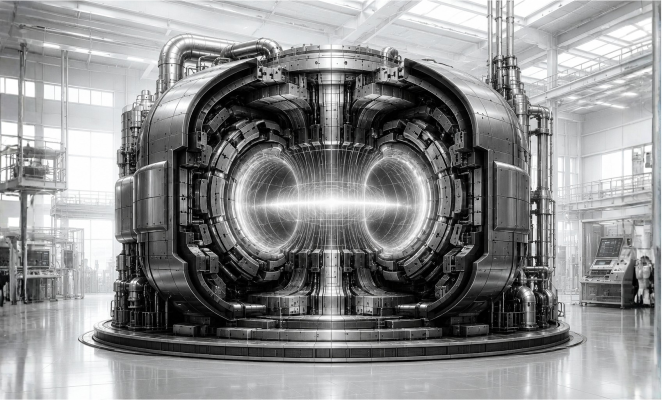
Worldwide annual energy demand increased from around 20.000 Terawatthours (TWh) in the late 19th century to 10x that, soon reaching 200.000 TWh, and continues to rise. Electricity consumption has grown at an even faster rate, jumping by one order of magnitude to 30.000 TWh since the 1960s. In Europe and many other parts of the world, we lack sufficient access to clean, renewable, low-cost, baseload, and flexible energy sources. Fusion promises the same profile and has absorbed $14.2 billion of private capital on the way there, with the constraint now sitting in manufacturing. Geothermal heat is already under our feet, and reaching it is an engineering problem. With Telura's technology, geothermal energy could become exactly that, the holy grail of energy, universally abundant.
Currently, geothermal energy is confined to very few locations, such as Iceland or the Pacific Ring of Fire, with sufficiently high geothermal temperature gradients, i.e., the rate at which the temperature increases with depth. As a consequence, global geothermal power generation is currently ~100 TWh annually, or 0.3 % of electricity generation. Yet, the potential of geothermal energy is unfathomable. At a depth of 10 km, temperatures reach an average of 300 °C to 400 °C. Based on extrapolations of extractable deep-heat data from MIT's landmark Future of Geothermal Energy report, this would unlock 180 million TWh of clean, baseload electricity, covering the surging energy demand for thousands of years. Yet, this vast energy vault remains locked away because the cost and difficulty of conventional mechanical drilling scale exponentially with depth.As we started thinking about and evaluating potential technologies to capture the enormous geothermal potential, we looked at approaches that would make geothermal energy indifferent to geography and geology. We started with the problem and were completely technology-agnostic.
As long-term energy demand continues to surge, driven, among others, by electrification and AI data center buildout, Europe remains in a vulnerable position at a time when energy security is a strategic necessity yet remains geopolitically contested. Existing renewables have seen dramatic cost reductions in the Levelized Cost of Electricity (LCOE) and have therefore seen more widespread adoption in many countries, but they have also introduced volatility to ageing grid infrastructure designed for decentralised generation.
More importantly, as we need to grow energy supply by an additional order of magnitude in the next decades, power generation density becomes an increasingly important factor. The surface footprint of wind (~20 kWh/m² per year) and PV (~150 kWh/m² per year) is one, or even two, orders of magnitude lower than ultra-deep geothermal plants (~5.000 kWh/m² per year). This extreme density allows geothermal plants to be built directly adjacent to urban demand centers, drastically reducing the need for new transmission infrastructure and enabling the direct reuse of existing grid connections from retired coal and gas plants.
Increasing the use of geothermal energy by 100-1000x would also address the fundamental bottleneck to European energy independence, making fossil-poor countries more resilient to political adversaries in general. Energy independence is one of the few areas where Europe can still build a lead of its own, which is the argument we made about Europe’s next industrial decades. Pioneers like Fervo and Quaise are already challenging the status quo, signalling a seismic shift in the geothermal landscape. However, we are seeing clear evidence that our novel drilling approach will deliver a 10x higher sustained rate of penetration (ROP) through hard rock, a leap in performance that will drastically accelerate global geothermal adoption and break through entirely new frontiers in subsurface resource extraction.
Today, conventional hydrothermal geothermal energy is geographically constrained to less than 5% of the continental surface that happens to have naturally high geothermal gradients and readily available underground fluids. A rare trifecta of high heat, a hydrothermal reservoir, and permeable rock is required for such plants to become commercially viable. But the physics of the Earth's crust offer a universal truth: if you drill deep enough, you will hit rock hot enough to generate cheap, clean baseload power almost anywhere. By economically unlocking depths to 10 km, we can expand the extractable geothermal potential from that tiny 5 % fraction to over 70 % of the planet's landmass.
However, the industry is currently trapped in an exponential paradox. While the thermal energy output increases almost exponentially with depth, the cost of reaching it does too.The root cause of this cost barrier is that conventional mechanical drilling is a prime example of incremental innovation. For over a century, rotary drill bits have been highly optimised for the oil and gas industry. But oil and gas are found in relatively soft, shallow sedimentary rock. Deep geothermal requires boring through high-temperature, ultra-hard crystalline basement rock (like granite).At these depths, the brutal temperatures and abrasive rock cause catastrophic wear and tear on mechanical bits. The constant need to stop, pull the entire drill string out of a multi-kilometre hole, and replace the worn-down bit substantially reduces the drill rig's uptime as drilling deepens into the crust.
Furthermore, legacy drilling forces developers to play an expensive game of geological roulette. Traditional projects require drilling deep to find natural "hotspots" where both heat and fluid are present. This frequently results in multimillion-dollar dry holes and, hence, big financial risks. By mastering deep, hard-rock drilling, we can abandon these expensive exploration gambles entirely. Instead, we engineer closed-loop systems in dry rocks where the heat flow is consistent and entirely predictable. Such designs transition geothermal from a high-risk exploration venture into a scalable, predictable energy manufacturing process. We just need a fundamentally different way to break the rock.

To unlock "geothermal anywhere," we first had to overcome the industry's biggest challenge. Conventional geothermal is tied to rare geological hotspots, while Enhanced Geothermal Systems (EGS) rely on hydraulic fracking, a process linked to induced seismicity, banned across much of Europe and impractical near population centres. Our solution is a closed-loop system. Because rock temperatures reach 400 °C to 500 °C almost anywhere at depths of 10 to 20 km, this approach makes baseload power entirely geology-agnostic.It enables a modular, 3D well architecture in which multiple laterals branch from a single wellpad, allowing us to add capacity directly where it is consumed by numbering up the "fingers" of the well. By circulating fluid through sealed underground pipes, we eliminate fracking, avoid toxic chemicals, prevent seismic risks, and make energy yields very easy to estimate.
But realising this "geothermal anywhere" vision requires reaching depths that destroy conventional mechanical drill bits. As we started evaluating possible technologies to capture this enormous potential, we were completely technology-agnostic. We investigated various non-mechanical drilling approaches and spoke with industry experts and research groups. We considered several approaches: millimetre-wave drilling, laser drilling, plasma torches, flame spallation, water jets, steel pellet shooting, and hybrid mechanical-contact drilling, to name a few. Initially, we strongly favoured surface-mounted systems such as millimetre-wave and laser drilling. But the physics quickly revealed a fatal flaw: pushing microwaves down a 10-kilometre waveguide is highly complex and results in >90% energy transmission losses. Furthermore, the waveguides themselves would require intense cooling at extreme depths, creating several insurmountable engineering bottlenecks. This realisation led us directly to Electric Impulse Drilling (EID).
EID uses high-voltage pulses with high repetition rates to create plasma channels directly inside the rock, heating and expanding it until it explodes from within. The fundamental physics of this technology have already been proven through years of rigorous research at TU Dresden, ETH Zurich, and Karlsruhe Institute of Technology (KIT), and proof-of-principle has been demonstrated in various cases. We have since established partnerships with these leading labs to rapidly commercialise the technology. From a physics perspective, EID is fundamentally the ultimate method for breaking hard crystalline rock. Legacy drills, lasers, and microwaves overcome the rock's compressive strength by crushing, melting, or vaporizing it. EID attacks the rock's tensile strength by ripping it apart from the inside, which is 10 to 20 times more energy-efficient, enabling much higher drilling speeds at a given cooling capacity.
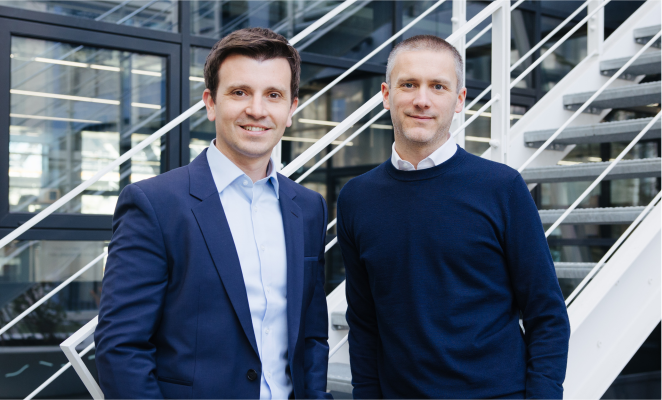
To turn this physics into breakthrough technology, we assembled the perfect founding team. Philipp Engelkamp, Co-Founder and CEO, industrialised complex energy hardware from a university spin-off into a 200-employee powerhouse with over €200 million in funding with INERATEC. Andrew Welling, Co-Founder and CTO, orchestrated large-scale engineering programs as VP of Program Management at Lilium and Rolls-Royce. Together with a team of fabulous engineers, we are ready to bring this truly disruptive drilling approach from a lab-proven concept to a field-grade, commercial system. The path is clear, and the remaining engineering challenges are solvable.
Soon, we will start drilling-as-a-service, systematically test systems early and often in real-world conditions to gather data, and become proficient in drilling operations. Within the next year, we will deploy prototypes, drilling deeper and faster through hard rock than competitors who have already raised hundreds of millions of dollars.
By eliminating the mechanical wear and tear that plagues legacy drills, we will finally achieve linear drilling costs. This fundamentally changes the math of subsurface energy, transitioning geothermal from an expensive gamble into a predictable manufacturing process. Ultimately, our goal is to drive geothermal energy costs down to sub-30 €/MWh, drastically undercutting fossil fuels and making baseload clean energy financially disruptive.

As we scale our depth capabilities to 10 km and beyond, we reach supercritical conditions at 400°C to 500°C. This is the ultimate game changer. At these extreme temperatures and pressures, water transitions into a supercritical state that holds vastly more thermal energy than standard steam. A single supercritical well can provide utility-scale power capacity with a very small surface footprint.
The heat is beneath our feet, almost indifferent to geography or borders. But to finally unlock it, we must leave behind the mechanical limitations of the past. Electric Impulse Drilling is the key to economically breaking the hard-rock barrier. Telura is on a mission to tap into this vast, clean energy vault and leapfrog global geothermal power generation. One drill at a time.