Let’s be honest about where we’ve been. For the past 10-15 years, Europe’s tech talent has primarily focused on software, e-commerce, and B2C. We optimized grocery delivery to under 10 minutes. We built copycat models of American success stories. It was a necessary phase, but also a detour.
Now, we’re seeing something different. That same talent is moving back to solving problems in the physical world. Back to what made Europe prosperous in the first place: clever engineering shipped as ‘made in Germany,’ Concorde pushing speed limits, and pharmaceuticals that didn’t just discover molecules but actually produced them at scale.
Take telura, one of our portfolio companies. They’re reinventing ultra-deep drilling to make geothermal energy abundant almost anywhere on earth. The technology was pioneered over a decade at the Technical University of Dresden, but the researchers never attempted to commercialize it. They were iterating under lab conditions, one version after another. This shows you how much European tech ambition has changed, and we exist to enable exactly these kinds of companies.
Three forces are converging that make this moment different:
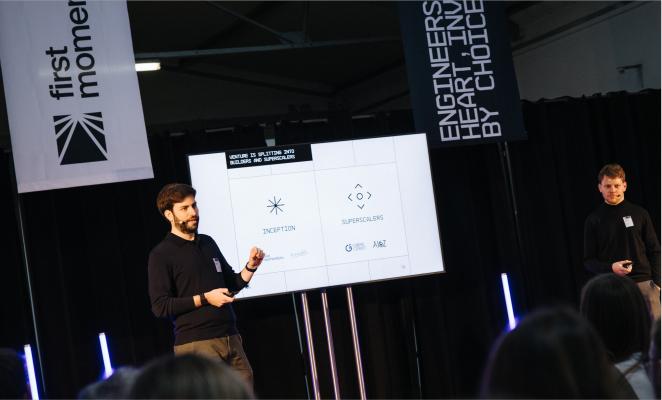
This isn’t just growth, it’s a structural shift. The venture ecosystem now has specialized players at every stage, from company building to massive growth capital.
Let’s address a persistent myth: that hardware isn’t a VC case. The reality? 80% of the world’s most valuable companies are combinations of software and hardware. Apple, Amazon, TSMC, Tesla, they all started with physical products.
The reason is Wright’s Law, the experience curve effect. Every tripling in production output of a sufficiently defensible hardware technology leads to a 30% reduction in specific costs. These compounds. You can see it in industrial robots, PV modules, chips, and airplanes; costs declined rapidly over decades, leading to wider adoption.
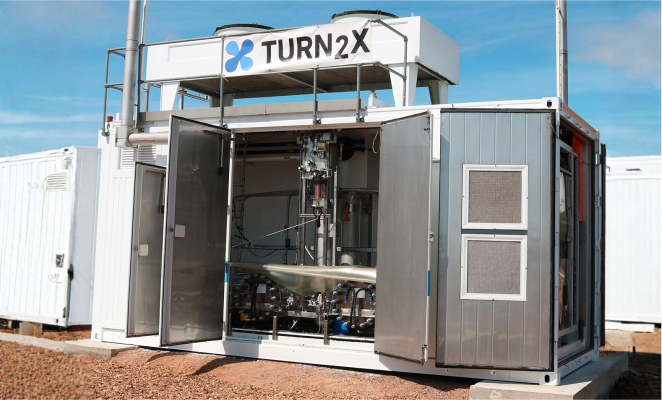
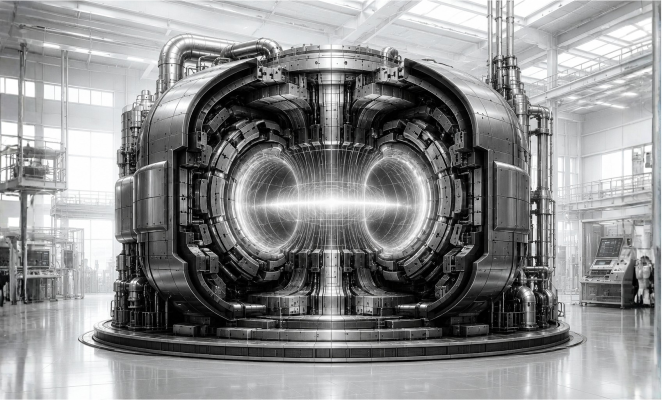
For defensible technologies, this inevitably leads to 80-90% gross margins. We’ll see this applied to portable MRIs, modular chemical reactors like those from Turn2X, precision manufacturing from Daedalus, and even modular fusion reactors. Hardware doesn’t just work as a VC case; it can become your biggest moat.
Every year, we publish our Deep Tech Napkin, tracking how the ecosystem evolves. One thing is crystal clear: Deep Tech founders aren’t looking for SaaS VCs rebranding as Deep Tech investors.
They need:
This is where our Scout network becomes critical. PhDs, expert researchers, engineering leaders, and founders help us reach into different pockets of expertise. One example: a portfolio company needed spare chemical reactor capacity to scale production. Within days, we connected them with six times the capacity they were looking for. That’s not something you get from most funds.
Being contrarian is easy. Anyone can go against the mainstream. What’s incredibly hard is being contrarian and right.
You need the right perspective on why tomorrow differs from today. But you also need dozens of things aligned perfectly for a vision to become inevitable, where talent, capital, and support rally behind a consensus.
Look at funds that did things differently. Founders Fund, backed by Peter Thiel, built ownership positions across multiple fund generations and stages, co-incubating companies like Anduril and Palantir, then following through to pre-IPO and beyond. Hummingbird invested 30-40% of a fund generation into BillionToOne, a tech bio company in a vertical they’d never touched before.
Meanwhile, Europe spent the last decade cloning American copycats and diluting founders into insignificance. That has to change.
When we started First Momentum, Deep Tech investing wasn’t common among VCs. We were contrarian bets ourselves, clear underdogs, outsiders between dorm rooms and lectures at Karlsruhe Institute of Technology.
We realized there was a disconnect between European founders and investors. So we built the fund we wished existed: engineers at heart, investors by choice, partnering with deeply technical teams at the earliest possible moment.
With our second fund, we became more pan-European and flexible, able to co-lead or lead pre-seed rounds. We sharpened our focus on the cusp of what’s possible: new industrial technologies, energy transition, and novel computing. We’ve also built select positions in aerospace, software infrastructure, and tech bio.
The data is becoming clearer every day; this portfolio approach enables far superior returns than the industry average.
But we’re not passive investors. We get our hands dirty while staying subject matter experts. Our scout network and industry partners amplify our lean team. They help founders navigate industry ins and outs, take risks on early-stage companies, and mobilize networks to build momentum.
We’re technology agnostic and value our independence, whether co-investing or leading rounds ourselves. We’re low on ego, high on impact. Trust means everything to us.
What matters most? A founding team that’s relentlessly pushing forward, obsessed with their problem. When those conditions are met, we want to be partners as early as possible. We underwrite Europe’s boldest bets, unconventional, contrarian, or simply overlooked opportunities.
If we do this 50 times, backing companies like telura that provide abundant energy, Daedalus building industrial capacity, and ventures solving computing bottlenecks, we’ll ignite Europe’s next industrial decades.
The Deep Tech ecosystem is moving in the right direction, building real momentum. We have all the necessary ingredients: talent returning to complex problems, capital flowing into Deep Tech, and an ecosystem specializing in every stage.
The basic thing is just to let’s do it.