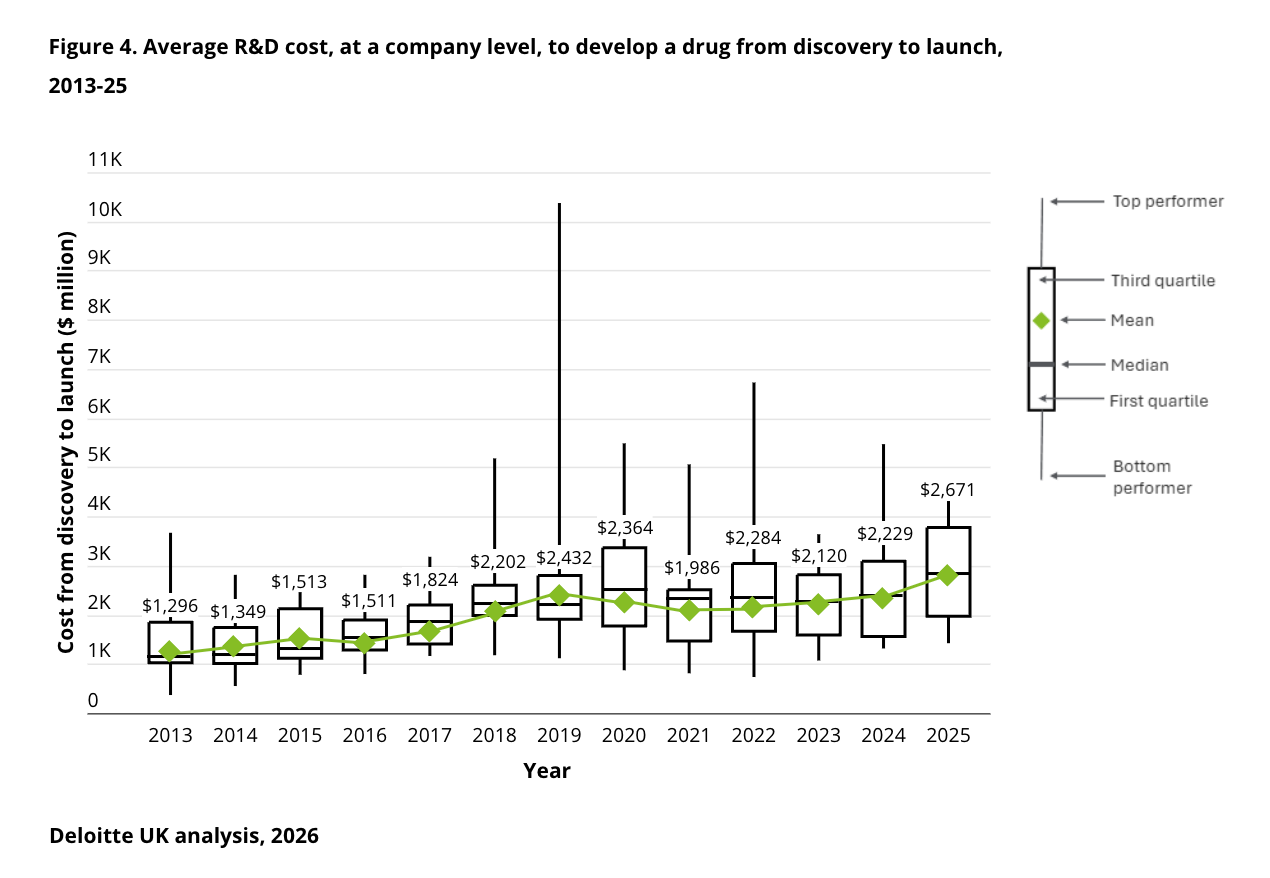
About 70% of Phase II trials fail, and that figure is consistent across industry analyses (including research published in Nature Biotechnology). A single trial can cost more than $100m and runs for 2 to 3 years. Bringing one approved drug to market costs around $2.7bn and takes more than a decade. Most of that capital is committed before anyone knows whether the Phase II bet was right.
The failure rate is high. The reasons behind it are quite specific. Around 30% of drugs fail to show an effect on their selected disease in Phase II. At the same time, roughly 60% of all approved drugs treat a different condition more effectively than existing treatments, according to Atlas Bio. In many cases, the molecule works, but the trial targets the wrong disease or patient population.
Today's process has no mechanism to test a drug across all possible indications before committing to a Phase II design. You pick your best guess, recruit thousands of patients, and wait. If you guessed wrong, finding that out costs hundreds of millions.
Atlas Bio runs that test first. Their in silico trial simulates multiple treatments on the same virtual patient profile, across all relevant indications, in 12 weeks. That shows where a drug works before anyone commits capital to a Phase II.
"For sixty years, drug development has been built on two flawed assumptions: that mice predict humans, and that the only way to learn whether a drug works is to give it to thousands of patients and wait. Both are now becoming outdated. Human biology is finally legible to AI, and that changes the economics of this entire industry."
Simon Romanski, CEO and co-founder, Atlas Bio
Simon Romanski (CEO and co-founder) studied computer science at KIT and EPFL and worked on autonomous driving at Stanford before co-founding Atlas Bio. Outside the lab, he runs ultramarathons, including 142 km across the Alps in a single day.
Sebastian Bayer (CTO and co-founder) led large language model research at Google. He and Simon had already built comparable data and model architectures before Atlas Bio.
Both were early contributors to autonomous driving. They built systems that learn from large, noisy datasets and make predictions that hold up under real-world conditions. Their approach to training biology models on large-scale human data comes directly from that work.
Dominik Hartl (CSO) trained as a doctoral fellow at the Friedrich Miescher Institute for Biomedical Research and spent more than a decade in drug development. At Idorsia (a spinoff of Actelion, which J&J acquired for $30bn), he built machine learning models for indication discovery and biomarker analysis. These models identify the patient groups most likely to respond to a given drug candidate. At Atlas Bio, he leads scientific strategy and translates the model's outputs into the decisions pharma teams act on.
So the three of them cover both sides: large-scale AI predictions and the clinical decisions that determine which drugs reach patients. Atlas Bio applies that combination to the biggest bottleneck in drug development.
The pharmaceutical industry spends roughly €55bn on R&D every year (across European companies alone). With 70% of Phase II trials failing, a substantial share of that budget goes into exactly the stage Atlas Bio targets.
Also, pharma portfolio value today is concentrated in fewer, larger programs, and development costs grew by nearly 20% in a single year. So each wrong Phase II bet now costs more capital than ever before.
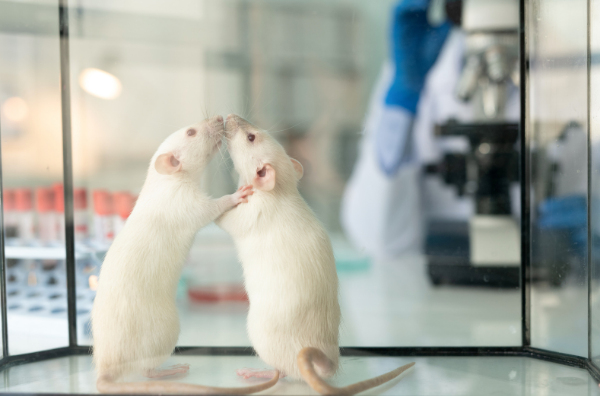
The regulatory window opened in early 2023. The FDA Modernization Act 2.0 removed the mandate to test drug candidates on animals before human trials. The law makes animal testing optional and authorizes in silico evidence, including AI-based simulations, in its place. Atlas Bio is among the first companies positioned to supply that evidence at commercial scale.
"Every failed Phase II trial is a treatment that didn't reach a patient who needed it, and the cost of that failure has become impossible to defend when the technology to fix it exists. Atlas Bio is the end of Phase II as we know it, and the end of animal testing as the price of progress."
Simon Romanski, CEO and co-founder, Atlas Bio
The second shift is technical. Foundation models trained on human biology have only become viable in the last 2 to 3 years. Large-scale RNA datasets, transformer architectures, and the compute to train across 500,000 individual patients only crossed that threshold recently. At NVIDIA's GTC conference in 2024, Jensen Huang said: "For the very first time in human history, biology has the opportunity to be engineering, not science." We think Atlas Bio was built at the right moment to use it.
Therefore, the commercial opportunity is at the Phase II bottleneck. It is the stage that costs the most and fails the most, and for sixty years it has had no systematic solution.
When we invested at pre-seed, Atlas Bio had just incorporated. The founding team was validating its data strategy and early model architecture. No commercial contracts and no external data partnerships.
Eighteen months later, the model is already used productively in drug development. A Basel-based biotech client eliminated animal testing from a specific workflow and moved directly to human trials based on Atlas Bio's output. The company also partnered with leading research institutions and hired researchers from DKFZ, Oxford, and Actelion.
Atlas Bio's model is trained on roughly 2 million RNA readouts from human tissue. RNA readouts show how genes switch on and off inside the body. The model learns those patterns across a population of more than 500,000 individuals. That way, it predicts how a drug will behave in each patient of a virtual cohort, across all indications at the same time.
"Most biological effects are not caused by drugs. To predict unknown drug effects, we need to learn biology in an unbiased way. By training our foundation model on roughly 2 million human RNA readouts, we can generalise across indications and treatments, enabling simulations that aren't tied to one disease or one mechanism."
Sebastian Bayer, CTO and co-founder, Atlas Bio
The output is a 12-week simulation that tests multiple treatments on the same patient profile at the same disease state. In a live trial, that is physically impossible. Sponsors see which patients respond to which treatment for which disease, before they commit to a Phase II design.
Atlas Bio has completed a double-digit number of prospective and retrospective studies. Not a single prediction has failed to date.
"In silico trials can compress learning cycles from years to weeks, improving decision quality while supporting the industry's move toward more human-relevant evidence."
Dominik Hartl, CSO, Atlas Bio
In our view, the moat is the prediction record. Mapping RNA readouts onto clinical outcomes across indications, with a growing record of accurate predictions, is what gets embedded in pharma workflows and stays there. Every engagement adds to that record, and a validated history in clinical programs takes years to build.
At pre-seed, the case rested mostly on the team. We invested because the data strategy was sound and the regulatory window was opening. Also, their ability to execute was clear to us from the first conversation.
The following 18 months confirmed it. Atlas Bio moved faster on the product than planned and put together a scientific advisory board with pharma executives. And their first commercial outcome eliminated animal testing in a client workflow.
"Atlas Bio is chasing one of the biggest prizes in science: making human biology something we can actually read and predict. For decades the industry has accepted that most drugs fail and most discoveries come down to luck. Atlas Bio is building the foundational AI that changes that, and the ambition and clarity behind the science is rare at any stage, let alone this early."
Sebastian Böhmer, Founding Partner, First Momentum Ventures
Creandum leads the seed round, and First Momentum and LEA Partners continue from the pre-seed. Total financing is now $13.2m. The capital goes into expanding Atlas Bio's scientific and commercial teams, deepening platform validation, and onboarding further enterprise clients.
The goal is a foundation model for human biology that increases the probability of Phase II success and runs trials that ethical constraints and resource limits have made impossible until now. If the team pulls that off, animal testing becomes a relic of the time before machines could read human biology.