Turn2X converts renewable electricity and CO2 into e-Methane, a molecule chemically identical to fossil gas that runs through the infrastructure Europe already has. First Momentum invested at pre-seed and has now followed on into its €20M Series A.

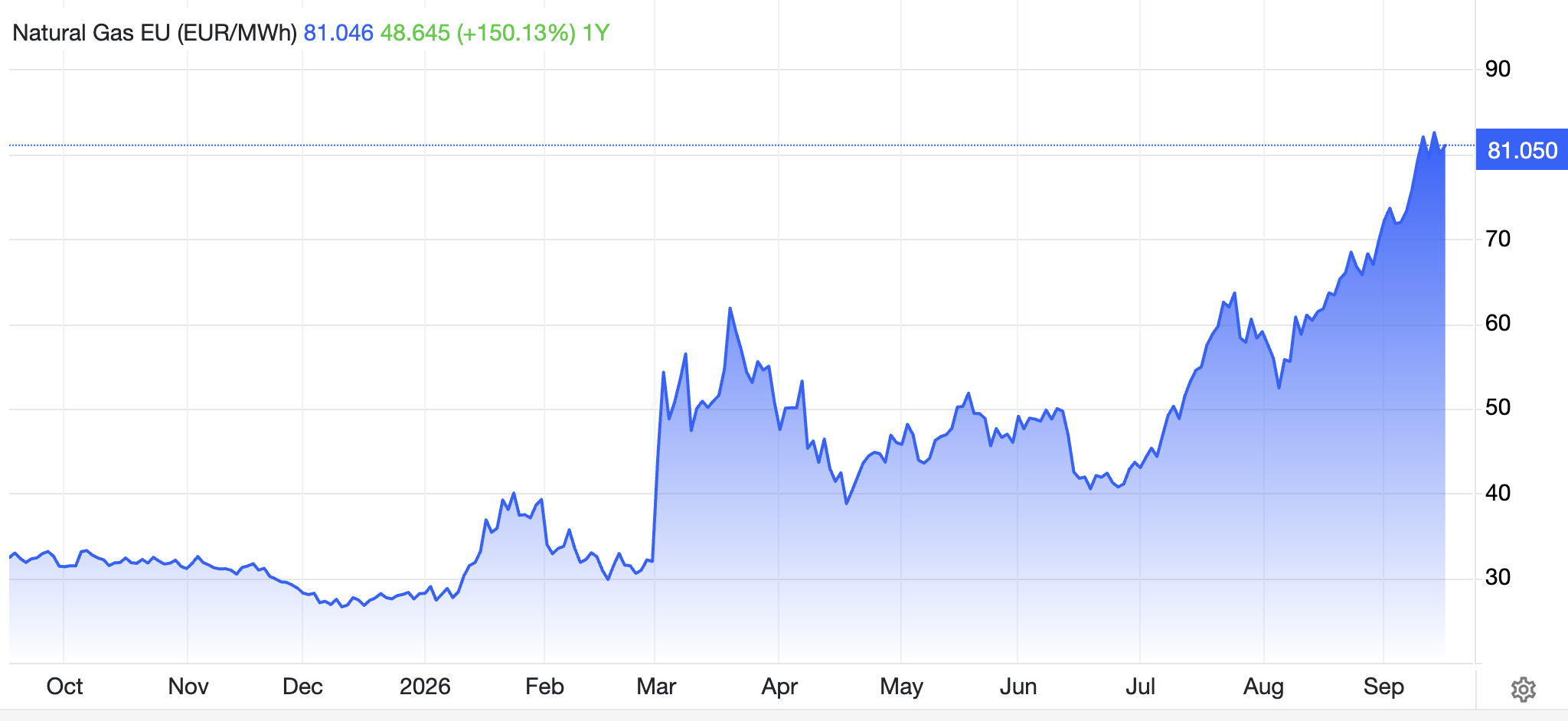
Europe's major gas price benchmark has passed €80 per megawatt-hour, roughly 2.5x where it was a year ago. Europe's underground gas storage, the buffer that carries the continent through the months when demand outruns what pipelines and tankers can deliver, sat at 57.1% full on 1 August. That is the lowest reading for that date in the record, against an EU target of 90%. The Strait of Hormuz, which carries roughly 20% of the world's liquefied natural gas trade, is effectively closed, Norwegian fields have run extended outages as annual maintenance overran and compressors failed repeatedly across several fields, and drought has cut hydro and nuclear output.
The grid has its own problem. In early September, German police opened investigations into two sabotage attacks on electricity substations within 24 hours, one of them examined for links to terrorism.
Electrification covers a growing share of European energy demand. Shipping, the high-temperature furnaces in glass and steel, and seasonal heat in buildings sit outside that share. They need a molecule: high energy density, storable for months, movable between continents. Europe imports roughly 88% of the natural gas it burns. And without new field investment, new research expects EU gas imports to pass 98% by 2050, as Norwegian output comes off plateau and Russian pipeline gas is phased out.
Batteries cover the short gaps, moving power across hours and days, which is the case we made when we backed encosa in industrial storage. Weeks, seasons, and shipping lanes are a different problem. e-Methane, a renewable, carbon-neutral synthetic gas, is well suited to solve it.
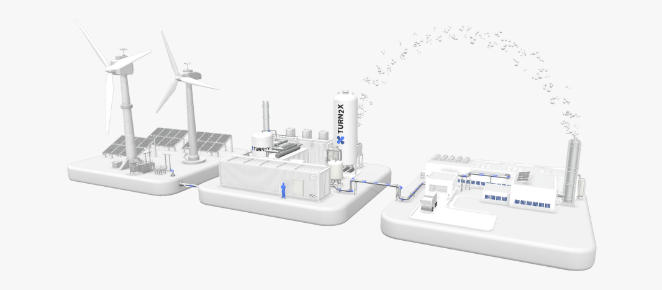
Turn2X designs its plants as what co-founder and CEO Philip Kessler calls resilience cells, pairing wind and solar with on-site e-Methane production and storage so a plant keeps running when the grid around it does not.
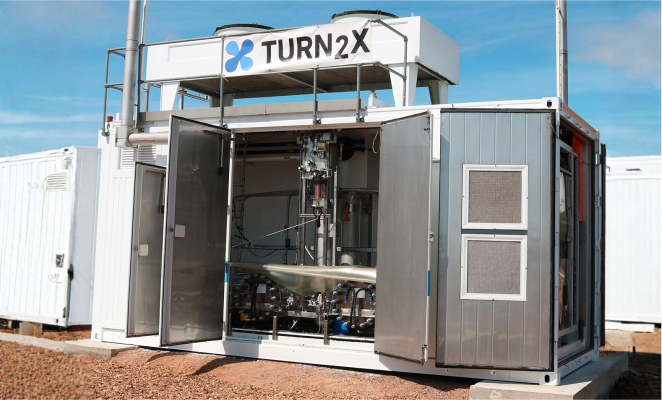
The chemistry Turn2X is using is not new. Electrolysis splits water into hydrogen and oxygen. The hydrogen then reacts with CO2 in a methanation reactor to produce methane. The output is CH4, the same molecule as fossil natural gas, with the same energy content and the same combustion behavior. Put it in a pipeline and nothing downstream changes.
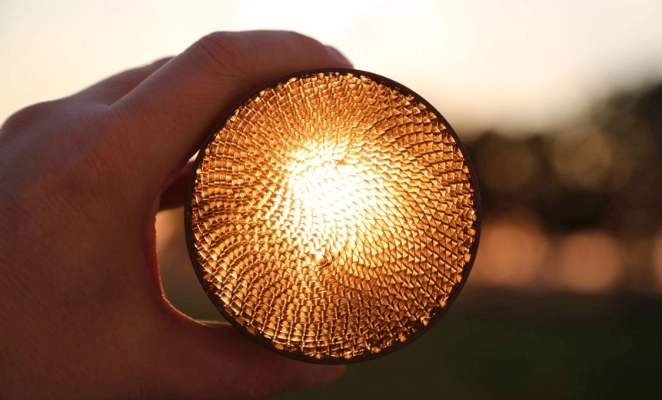
What Turn2X built is the reactor. Dominik Schollenberger spent more than a decade at the Karlsruhe Institute of Technology (KIT) on honeycomb methanation before co-founding the company. A honeycomb reactor takes its name from what it looks like in cross-section. A single metal block is drilled through with hundreds of narrow parallel channels, the same repeating cell structure bees build in wax. The channel walls are coated with catalyst, and the gas reacts as it passes through them, instead of flowing around the packed pellets a conventional reactor uses. The geometry pulls heat out far faster, which prevents the hot spots that constrain conventional fixed-bed reactors and lets the reactor change load in minutes.
That last property is the commercial one. Renewable electricity is cheapest in the hours when there is too much of it. A reactor that ramps in minutes runs during those hours and idles when power is expensive, so the plant buys its largest input at the bottom of the curve. Turn2X has filed 11 patents on its reactor design and the process.
The modules are small on purpose. Turn2X builds 9 MW units where most methanation projects propose mega-plants. In its European Innovation Council (EIC) project, the company puts the resulting CAPEX advantage at around 30%, from simpler heat management, standardized parts, and a smaller footprint. A small unit also sits beside a biogas plant that already vents biogenic CO2, removing the cost of trucking CO2 to site. And it can be built in months, not years.
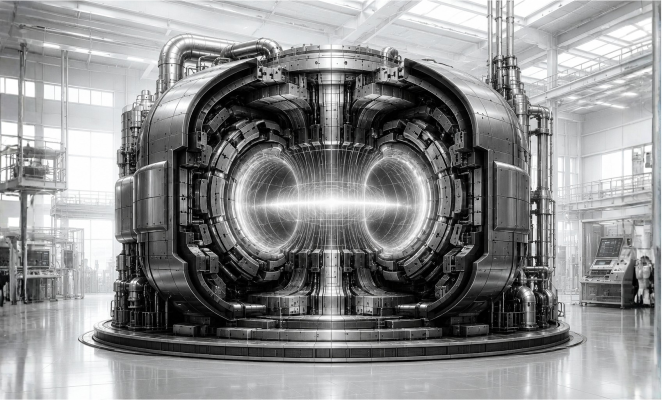
This is the same argument we have made about fusion. In energy hardware, the constraint is rarely the physics. It is how many units you can build, and how fast.
Turn2X has run a pilot plant in Brandenburg feeding renewable gas into the German grid since 2019. The commercial plant sits in Miajadas, in the Spanish region of Extremadura, and went into operation in 2025. Together, the two have logged more than 5,000 operating hours.
Spain was a deliberate choice: some of the cheapest renewable power in Europe, a well-built electricity grid, and a dense gas network to inject into.
Everything the Miajadas plant produces is already sold under long-term offtake contracts. That took three things:
Certification. In September 2025, Turn2X signed a power purchase agreement with Axpo Iberia, supplied by Aquila Clean Energy, making the site the first in Spain to produce methane certified as a Renewable Fuel of Non-Biological Origin (RFNBO). The gas also carries International Sustainability and Carbon Certification (ISCC). Compliance-grade paperwork is what utilities and shipowners are buying, and very few producers in Europe have it.
Operations. Siemens and Atmen built the layer underneath: Siemens supplied automation and a digital twin for remote plant management; Atmen supplied the data layer that turns RFNBO certification into a daily automated process rather than an annual audit. Remote operation decides the unit economics: one control room runs an entire fleet of distributed 9 MW plants, which is what lets the model multiply across sites.
Demand. In March 2026, Titan Clean Fuels signed an offtake agreement for e-Methane from 2028, to bunker into liquefied natural gas (LNG) fueled ships across roughly 52 ports. In the same month, Turn2X and AGR Biogás agreed to combine biomethane production with hydrogen-based methanation in Spain, which gives Turn2X CO2 supply and AGR a use for a waste stream. Turn2X also won a global tender run by one of Spain's largest energy majors, beating three of the biggest engineering contractors in the field to become its e-Methane technology provider.
E-Methane demand used to depend on voluntary decarbonization budgets. That changed with the EU's third Renewable Energy Directive (RED III), which for the first time sets binding targets for Renewable Fuels of Non-Biological Origin across the bloc: 42% of industrial hydrogen and 1% of transport energy by 2030. Member states had until May 2025 to write it into national law. Most missed that deadline, only 12 of 27 have legislated RFNBO quotas, and the Commission has opened infringement proceedings against nearly all of them.
The countries that did move are the ones setting the market. Germany went furthest. On 23 April 2026 the Bundestag adopted its transposition, with an RFNBO quota that starts at 0.1% in 2026, reaches 1.5% in 2030 and 10% by 2040, carrying a non-compliance penalty of €120 per gigajoule, around €430 per megawatt-hour and the steepest in the EU. RFNBOs count triple toward the overall quota until 2036, and the legislature's own estimate is that the obligation alone should support around 2 GW of electrolysis capacity.
Spain, where the commercial plant already runs, approved its own RFNBO quotas for road transport in July 2026, starting at 0.7% in 2028 and rising to 2.5% in 2030 and 11% by 2040. Italy and the Netherlands have transposed as well, and Denmark was the only member state to meet the original deadline.
A penalty that size sets a reference price for compliant molecules, and it applies whether or not a utility has an opinion about emissions. Shipping has a parallel mechanism: under FuelEU Maritime, RFNBO counts double toward compliance from 2025 to 2033.
What the market is short of now is supply. European e-Methane capacity stood at 449 GWh a year across 35 plants in 2024, according to the European Biogas Association, and only a fraction of that carries RFNBO certification.
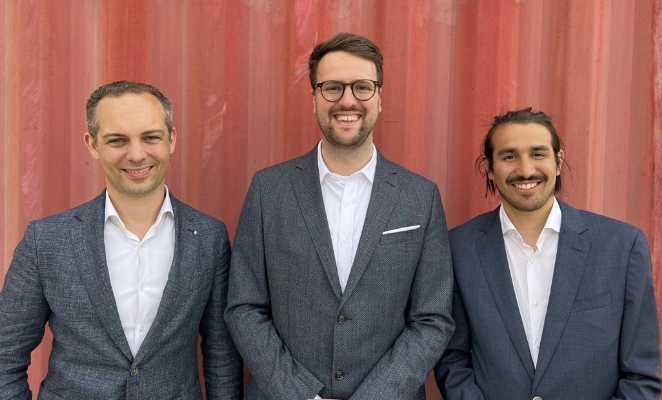
Philip Kessler co-founded Turn2X in Munich in 2022, after a sabbatical in Africa convinced him that methane itself could be made without fossil carbon. He had already built understand.ai and sold it to the global hardware-in-the-loop powerhouse dSpace. He met his co-founders during his studies at one of Germany’s top technical universities, KIT: Dominik Schollenberger, whose research the reactor is based on, and Benedikt Stolz, who runs operations and project finance.
The Series A brought in people who have built energy infrastructure at scale. Florian Antwerpen led the round for Antwerpen Ventures, switched sides, and joined Turn2X to run European project development. He co-founded Kyon Energy, taking more than 3 GW of German battery projects across 40 sites to ready-to-build, and sold the company to TotalEnergies for €90 million upfront plus earn-outs. He makes a cost argument from that experience: batteries looked expensive early, and the costs fell faster than nearly anyone forecast.
"My past work was about electrons. I'm now convinced the next frontier is molecules, and, above all, the combination of the two." Florian Antwerpen, Antwerpen Ventures
The team is surrounded by other great advisors. Tilman Weide, former Managing Director of Linde Engineering, sits on the board. Christoph Zinsser, formerly Head of Project Finance at Stegra, and Marcelino Oreja, former CEO of one of Europe's largest gas grid operators, Enagas, also invested in the Series A round.
First Momentum first invested in 2023, and the thesis was simple. Europe needs a molecule for the sectors electricity cannot reach. The gas grid is a distribution asset that already exists and is already paid for. Methanation is the one production route that plugs into it with no parallel infrastructure build.
Since then, each part has been validated. The reactor scaled from 1 MW to a 9 MW module. The commercial plant runs, is certified, and sells into contracts. The EIC put €2.4 million behind the technology after its own technical review.
What is left is cost. Turn2X reaches parity with biomethane and gets within reach of LNG by building in volume: more modules, cheaper components, cheaper power. We have seen that curve before in solar, where costs fell faster than almost every published forecast.
"We invested in 2023, when all of Europe produced under half a terawatt hour of e-Methane a year. What changed is that Turn2X’s plant in Spain runs, the gas is certified, and the offtakes are signed. What comes next is the cost curve and production scaling" Sebastian Böhmer, Founding Partner, First Momentum Ventures
The round will fund commercial plants across Spain and other geographies, further work to drive down production costs, and team expansion.
Europe is going to keep burning methane for decades, in the furnaces, ships, and boilers that already exist. Turn2X is building the capacity to produce that methane inside Europe, independent of other countries, out of Europe's own wind and sun. With this, they aim to avoid 1 gigaton of CO2 emissions, essentially Japan’s entire emissions for a full year, and displace 10% of Germany's fossil natural gas demand by 2031.