Before a 3D-printed part can fly or go into a reactor, it has to be qualified: proven sound by physical testing. The US National Institute of Standards and Technology (NIST) says that takes thousands of individual tests, costs millions of dollars, and runs for years. Change anything in the printing process, and it starts over.
A lot of that effort exists because nobody can simply look inside the finished part.
Industrial X-ray computed tomography is a standard tool, and it has a hard physical ceiling. A paper by the International Academy for Production Engineering puts the maximum penetrable thickness in steel at 0.5 cm for a 130 kV source and under 7 cm at 450 kV, the highest voltage in common commercial use. Megavolt linear accelerators reach further, but as the machine gets bigger, the resolution gets worse. Printed metal is harder again: NIST lists complex internal geometries and internal defects such as pores among the features that significantly challenge today's measurement techniques. The materials are worse for X-ray than steel, too. Engine components are increasingly printed from nickel superalloys, which are denser than the steel those penetration figures assume, and a scan has to cross the whole assembly rather than a single wall.
"X-rays reach their limit at a few centimetres of steel, yet much of modern industry, from reusable rockets to gas turbines, is built from metal far thicker, denser and more complex than that. Active muon imaging lets manufacturers see inside those large, dense components."
Dr Andi Hektor, Co-Founder and Co-CEO, MuRay
The cost of not seeing is highest where there is no second chance. One undetected flaw in a rocket engine can destroy a vehicle worth tens of millions on the pad.
So the parts that matter most are the parts that are hardest to inspect.
Muons are heavy relatives of the electron, about 200 times as massive, and they barely interact with matter. That is what makes them useful. They pass through dense metal, ceramics, and composites that stop X-rays, and the way they scatter on the far side gives you the density and the atomic composition of whatever they went through.
Nature supplies them for free. Cosmic rays hitting the atmosphere produce muons that reach the ground at roughly one per square centimeter per minute. Passive muography has used this for decades, from volcano interiors to nuclear waste casks, and it has become a commercial market. In October 2025, one of the largest global mining and metals corporations signed a five-year agreement to deploy cosmic-ray muon tomography across six of its largest operations. The flux is the constraint. At that rate, a scan takes hours, days, or weeks, which rules out anything attached to a production line.
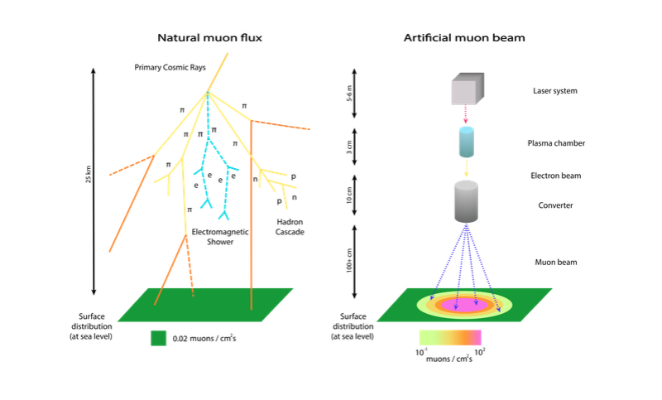
Making muons on purpose means using a particle accelerator. You accelerate electrons past 1 gigaelectronvolt (GeV), fire them at a tungsten converter, and the collision produces muons. A conventional linear accelerator needs around 100 meters to get electrons to that energy, which is why muon beams have lived inside research facilities.
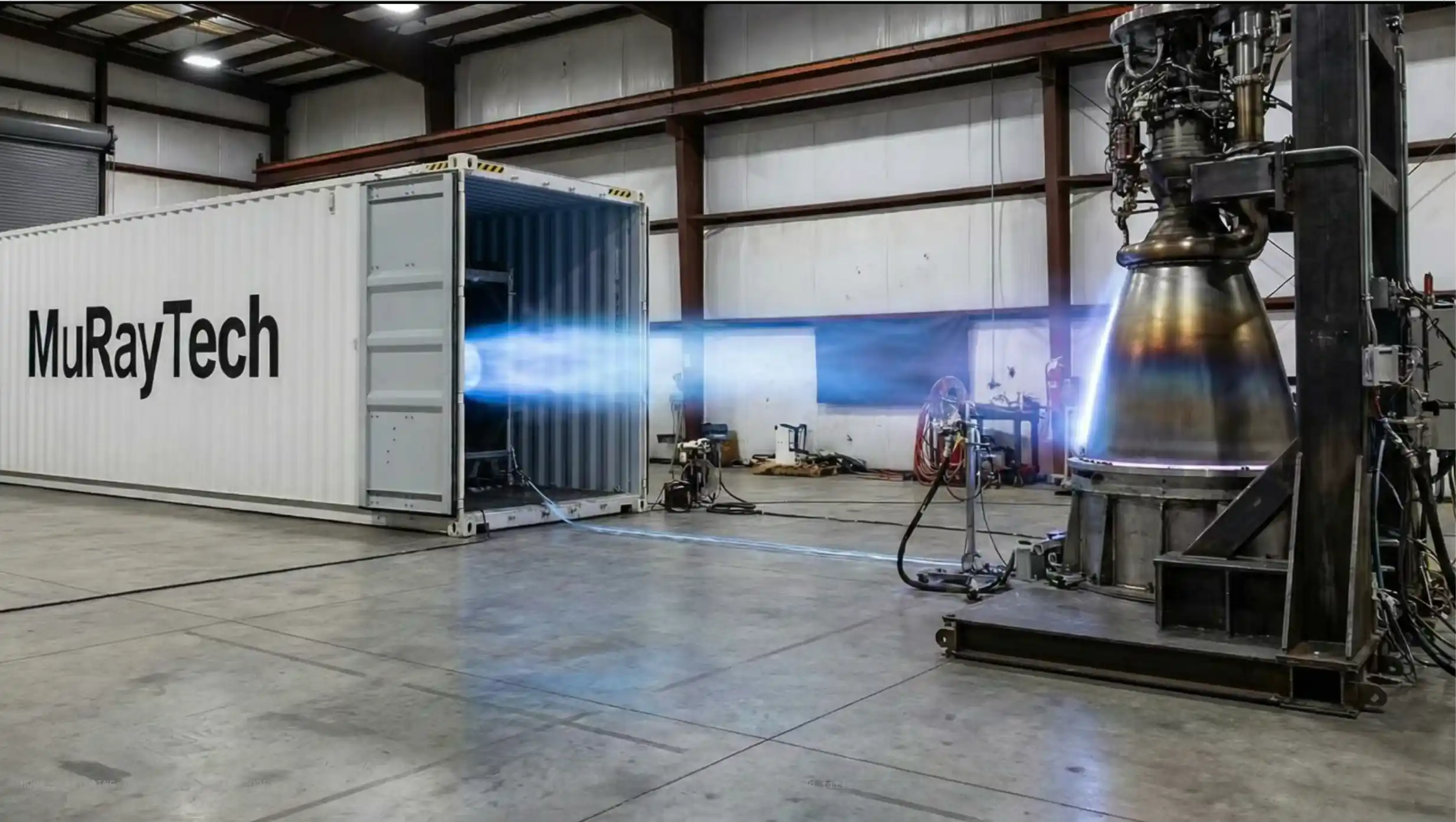
A laser-plasma accelerator does it in centimeters. A short, intense laser pulse turns a puff of gas into plasma and leaves a wave behind it. Electrons surf that wave. The acceleration happens thousands of times faster than inside a metal cavity, which is why the machine gets thousands of times shorter. MuRay puts that in front of a converter, beam optics, and a pair of detectors, and the whole chain fits into the volume of a shipping container. The next phase of development is exactly that: a mobile system the size of a container, so the machine travels to the component rather than the component to a lab.
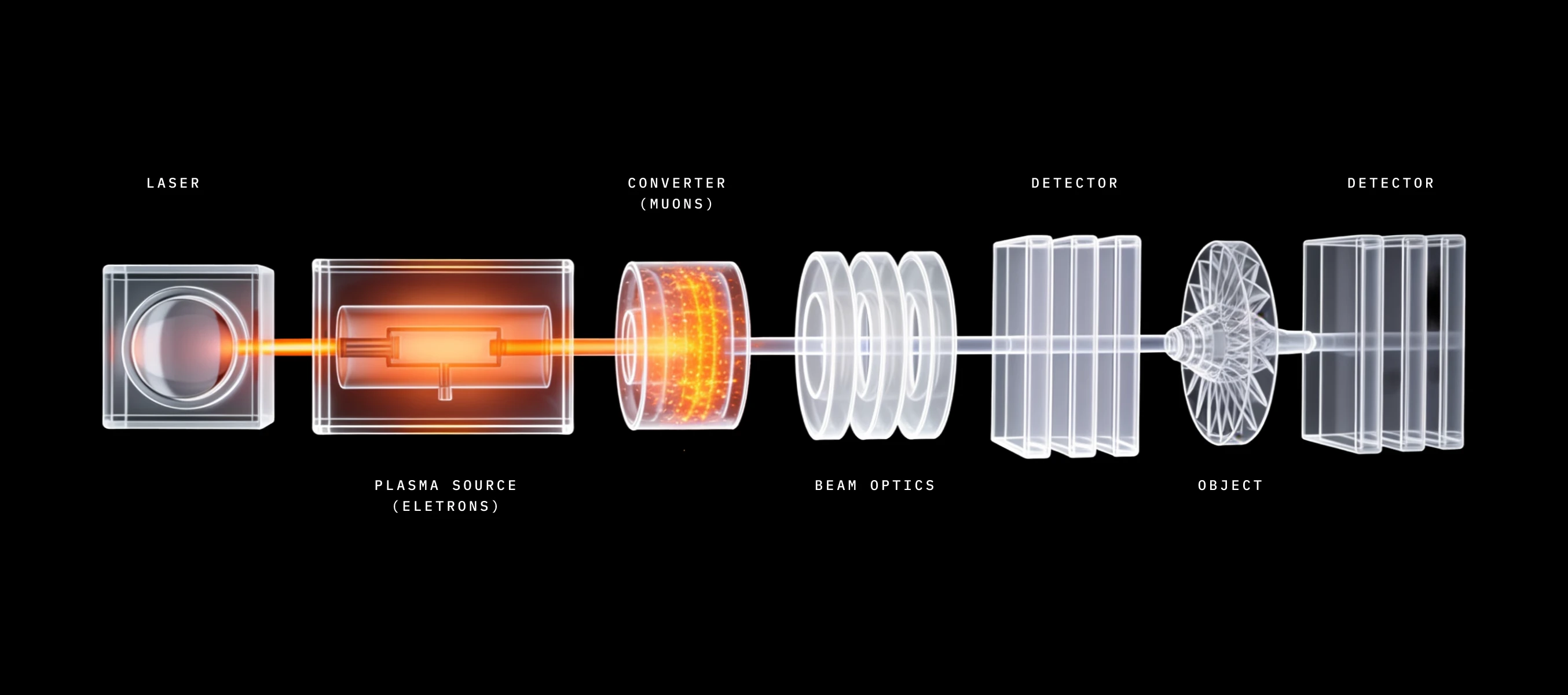
A conventional accelerator needs around 100 meters to push electrons to 1 GeV. A laser-plasma accelerator does it in centimeters.
The first service pairs DESY's existing electron beam in Hamburg with MuRay's own converter, detectors, and reconstruction software. It launches in early 2027 as the world's first Active Muon Imaging service. The first full-scale system with its own laser-driven accelerator follows in 2029.
Quality assurance in metal 3D printing is the first market. Printing is increasingly used for complex, safety-critical parts such as rocket engines and gas turbine components, and the industry has no inspection tool suited to dense printed metal.
The same capability carries across aerospace, defense, nuclear, and energy. Faster, more detailed inspection between uses shortens maintenance cycles for reusable rockets and jet engines and gets them back in service sooner. MuRay has modeled rocket-engine inspection with the German Space Agency at DLR and will carry out its first real-world engine assessment in 2027.
Because muons read material composition and have extreme penetration depths, the system can tell apart materials that look identical on an X-ray, including nuclear materials such as uranium, which X-rays cannot penetrate. Security screening is the fastest-moving application of that. European governments are stepping up investment in defense and border security, and MuRay is already exploring cargo and border screening on the back of it. Surveillance of radioactive waste and inspection of large structures such as bridge pillars and buildings come later.
"Defects that manufacturers can't see keep parts out of service for longer than they should be. Our technology helps them find those defects and get components back into service faster. This funding will help us continue proving the physics whilst delivering our first service to industrial customers."
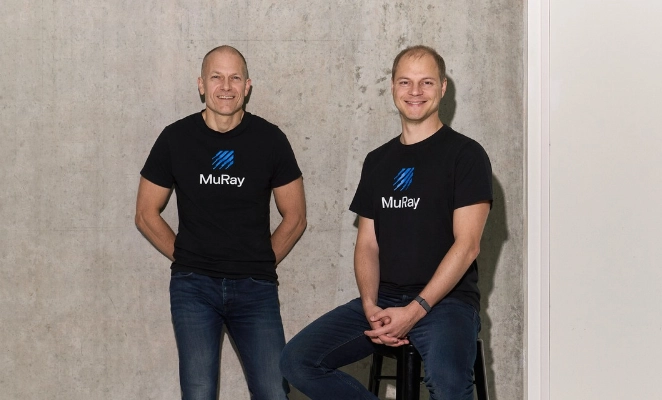
Dr Kristjan Põder, Co-Founder and Co-CEO, MuRay
Kristjan Põder is an accelerator physicist working on laser-plasma accelerators. He did his PhD at Imperial College London on self-guided laser wakefield accelerators, then joined DESY, one of the world's leading accelerator research centers, in 2017 as an accelerator fellow. There he led the team developing laser-plasma accelerators for industrial and medical applications, and directed the European research projects APHEX, LEAP, and VERA.
Andi Hektor spent nine years at CERN from 2004, first as a PhD student and then as a postdoc on the CMS experiment that discovered the Higgs boson. He holds a PhD in particle physics from the University of Tartu and has sat on the Estonian Government's Research and Development Council since 2024. From 2020 to 2025, he worked at GScan, which images large civil engineering structures with cosmic-ray muons. So he has already taken muon imaging to industrial customers and knows its potential firsthand.
MuRay's founding team members are among the few people worldwide with exactly the expertise needed to build this kind of technology.
We led this round because MuRay brings world-class physics from Europe's leading research institutions to one of modern manufacturing's biggest problems. Metal 3D printing, space, and energy are all growing quickly in Europe, and each of them needs a better way to inspect what it builds. Expertise in muon physics is rare. Expertise in laser-plasma acceleration is even more rare. Having both in one team is close to unique, and that is what makes Kristjan, Andi, and the people around them the group that can turn muon imaging into a practical industrial tool.
MuRay is the first team in the world building a portable laser-based particle accelerator for muon imaging.
Caelora co-led the round. It is a wholly owned subsidiary of Marvel Fusion, and the high-intensity lasers it develops are the same class of laser that drives a plasma accelerator. MuRay's full-scale system is built on that technology, giving MuRay access to laser expertise it would otherwise have to build from nothing.
The long-term case is bigger than industry. Muons deliver the same kind of information as an X-ray at a far lower radiation dose, which in principle means scanning a patient as often as a clinician wants to, rather than as rarely as the dose allows. X-ray is in every hospital, every port and every factory. Muons go everywhere X-ray already goes, and into the places it cannot reach.
Three years from now, a manufacturer should be able to scan a printed rocket engine part on-site and get back a full 3D image of its interior in minutes.