While AI coding assistants like Cursor and Claude Code have dramatically accelerated software development, they have inadvertently created a new bottleneck. Engineers now ship 10x the code, but ops is still gluing scripts and manual work together. Homegrown pipelines were never built for that scale. DevOps teams struggle to safely deploy, monitor, and manage this flood of changes. Traditional DevOps processes rely on tools connected by brittle scripts, manual approvals buried in chat threads, and tribal knowledge that disappears when engineers leave. This has become an acute pain point as AI code generation has gone mainstream.
SuperPlane emerged from this friction. The founders recognized that while AI was solving the development problem, the operational problem was worsening exponentially. But the answer is not AI making unchecked changes to critical infrastructure. Even a single misconfigured deployment can cause significant downtime, and infrastructure teams know this better than anyone.
What is needed is a two-tier model in which agents assist engineers via a deterministic platform with clear guardrails, visibility, and control. That is what SuperPlane is building: an open-source, AI-first control plane where engineers and agents collaborate safely on critical infrastructure workflows. You describe what you want in plain language, and it becomes a runnable workflow, complete with policy checks, approval gates, and a full audit trail of everything that ran. The result is teams shipping at scales that simply were not possible before. Through their open-source-first approach, teams today already get access to 400+ integrations spanning AWS, GCP, GitHub, GitLab, Slack, PagerDuty, Datadog, OpenAI, Claude, and more, covering almost any tech stack and enabling cross-tool automation at scale. A hosted cloud version is coming in Q2 2026.
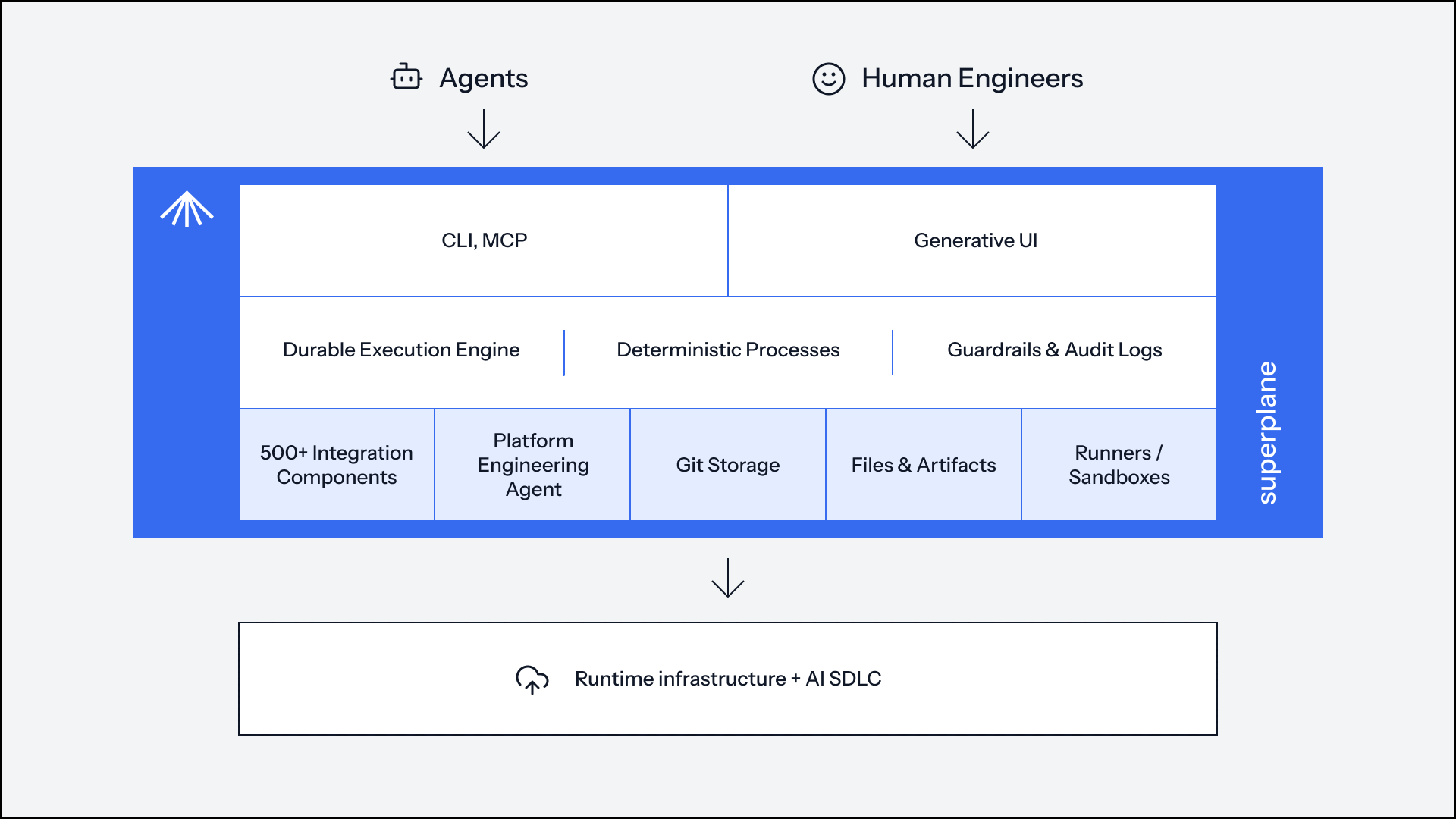
The way operations teams work today will look as outdated in ten years as ticketing systems do now. SuperPlane's vision is a fundamental restructuring of how engineering organizations run production systems. In the same way GitHub made code collaboration legible and scalable across entire organizations, SuperPlane has the potential to do the same for operational knowledge: taking what today lives in the heads of a handful of senior engineers and making it structured, auditable, and executable by anyone on the team. It fits a broader shift we have been tracking across the stack. The cloud layer needed a rewrite, and so does the operational layer.
Superplane is taking what today lives in the heads of a handful of senior engineers and making it structured, auditable, and executable by anyone on the team.
The on-call engineer at 2 am stops firefighting manually and instead supervises a system that already knows what to do. AI agents become first-class participants in production workflows, not because they are given unchecked autonomy, but because SuperPlane gives them the guardrails, context, and policy framework to act safely. In a world where AI is rapidly becoming a core part of every engineering team, SuperPlane is the operating system agents run on when they interact with critical infrastructure.
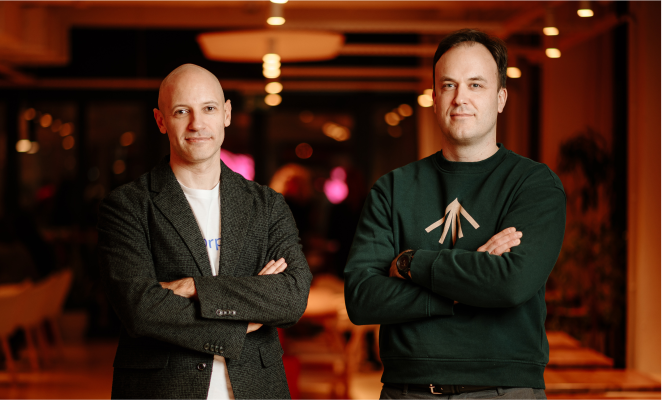
Marko Anastasov and Darko Fabijan have been building software companies together for nearly two decades. Their previous venture, Semaphore, became a CI/CD platform trusted by engineering teams at Confluent, Replit, and Superhuman. What stood out during our due diligence was not just the customer logos but the customer sentiment. Engineers who had worked with them described it as some of the best products and support experience they had ever encountered from a developer tools company.
Darko and Marko have spent over a decade in the trenches of DevOps, winning highly competitive deals against much larger vendors at some of the world's most respected engineering organizations. They know how these teams think, what they need, and crucially, what they will not tolerate. That kind of hard-won domain credibility cannot easily be replicated. It is built over years of shipping, iterating, and earning trust in one of the most demanding buyer categories in software.
The broader team they have assembled carries the same DNA. It's packed with veteran engineers from Semaphore who understand the intricacies of large-scale production deployments at their core.
The timing for SuperPlane could not be better. AI and machine learning are fundamentally reshaping how software is built, and the operational layer that supports it has become the new bottleneck. The market opportunity spans the multi-billion-dollar DevOps tooling ecosystem, and we are at a tipping point where manual processes simply cannot keep up with the pace of change. Engineering teams are not just looking for incremental improvements. They are actively seeking a new category of tools.
What makes SuperPlane defensible is not just the product but the problem itself. The same thesis holds across verticals: AI agents need guardrails to operate in critical environments, whether that is procurement or production infrastructure. Maintaining reliable integrations across the entire DevOps toolchain requires deep state awareness, role management, and policy enforcement that generic workflow platforms cannot provide. End-to-end platforms are locked into their own ecosystems. Incident-focused tools address only specific use cases. SuperPlane tackles the broader operational workflow challenge in the vendor-neutral environments where most engineering organizations actually operate. That is a significantly harder problem to solve and, therefore, a significantly harder position to compete with. Their open-source first approach deepens that moat further. In developer infrastructure, community trust is a competitive advantage that closed platforms simply cannot replicate.
AI is generating code faster than operations can handle, and the tools to bridge that gap simply do not yet exist at the level of reliability and control that production environments demand.
It is also rare that you meet founders like Darko and Marko. Few founding teams combine the depth of domain expertise and the shared entrepreneurial history these two bring. With Semaphore, they proved that a bootstrapped company from Serbia could out-execute much larger vendors and win the trust of some of the world's most respected engineering organizations. That kind of grit and technical excellence is exactly what we are searching for in founders, and we are confident they can build a global DevOps champion with SuperPlane.
The window to define a new Platform Engineering category is open right now, and SuperPlane has everything it takes to claim it. AI is generating code faster than operations can handle, and the tools to bridge that gap simply do not yet exist at the level of reliability and control that production environments demand. SuperPlane is purpose-built for exactly that problem, in a vendor-neutral way that no end-to-end platform or point solution can replicate. And behind it are two founders who have spent nearly two decades earning the trust of the world's best engineering organizations, and who know exactly what it takes to win in this market. Timing, product, and team rarely align this cleanly. That is why we are backing them with high conviction, and we can't wait for the journey ahead.
Learn more about SuperPlane here.