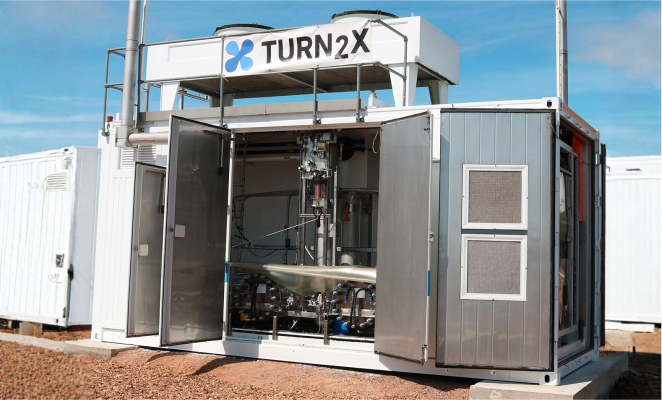
First Momentum is doubling down on ISPTech by joining its €5.5M Seed round. The Stuttgart-based company has spent a decade turning German Aerospace Center research into flight-ready propulsion systems, and is poised to become the propulsion supplier for Europe's next-generation space missions.

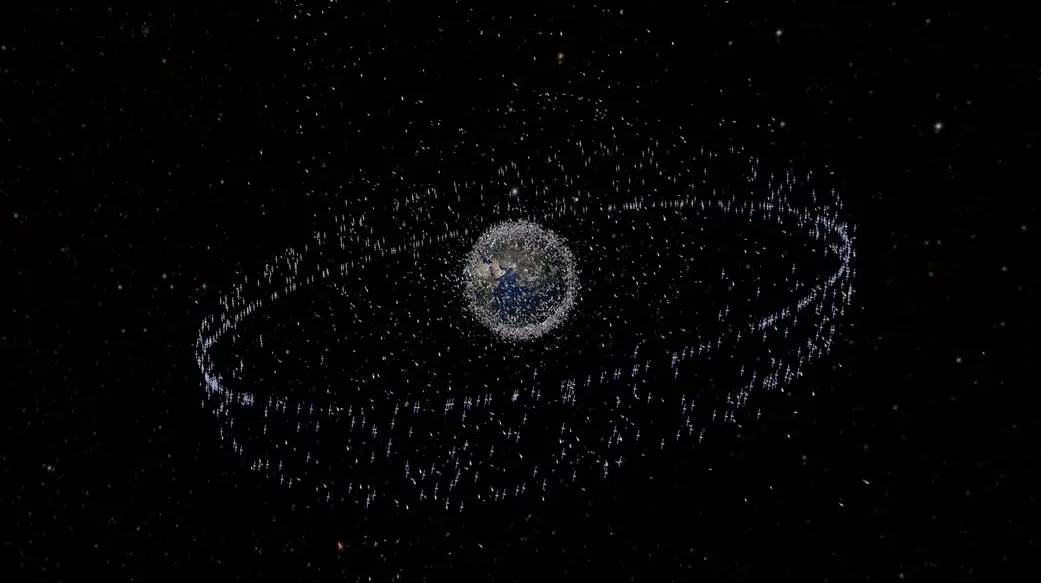
Launch costs are dropping, and soon, access to space will no longer be the primary constraint. With Starship approaching operational status, New Glenn in flight, and the first European microlaunchers proving out, launch capacity is increasing fast. The result is a more crowded environment, with commercial constellations, capsules, stations, and sovereign defense programs all pushing into space. And mission profiles will grow more complex. Beyond orbit keeping and “simple” collision avoidance, operators need to reposition quickly, service other spacecraft, and protect constellation assets in real time. The sooner a satellite reaches its target orbit, the sooner it generates revenue. Time is money in space, and cost-effective, high-thrust propulsion has become a critical, yet underrated capability in the European space industry.
Electric propulsion is efficient but painfully slow. It handles orbit maintenance and gradual station keeping well, but cannot deliver the thrust needed for fast repositioning or time-critical maneuvers. Chemical propulsion solves the speed problem, but conventional hydrazine-based systems are prohibitively expensive and face mounting regulatory pressure due to their extreme toxicity. The non-toxic alternatives that have emerged to replace them largely underperform where it matters most.
The market has been waiting for systems that deliver both reliability and performance without requiring spacecraft operators to become propellant handling experts.
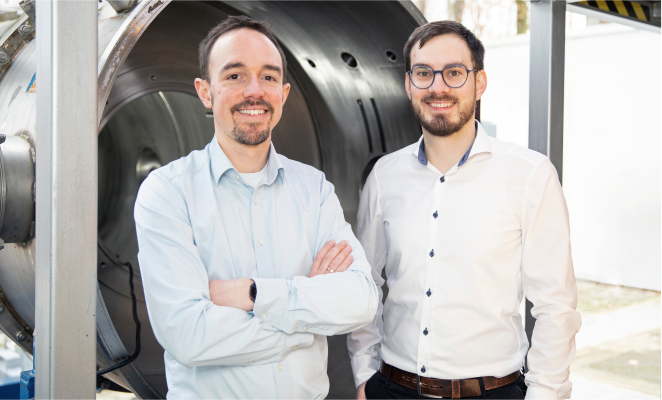
The founders, Lukas Werling and Felix Lauck, spent over a decade at DLR’s Institute of Space Propulsion, where they built far more than a publication record. Seven patents and more than 50 papers are the output of a team that developed, tested, and qualified propulsion systems under mission requirements. Lukas ran programs and managed full development cycles. Felix turned HIP11 from a PhD concept into demonstrated technology and became one of Europe’s leading experts in hypergolic ignition. Together, they have assembled a world-class engineering team that developed its first customer system in record time: from design to qualification in less than 12 months.
Founder profiles like this are now the norm in European deep tech. 90% of pre-seed founders hold a relevant PhD, up from 81% a year earlier, and most raise while the technology is still at lab demonstration stage. ISPTech raised with qualified hardware and signed contracts, which is a stage ahead of the field.
“Regular, reliable, and affordable access to space via reusable rockets is possible now. However, the true in-space ecosystem will only be unlocked by mobility solutions for satellites and spacecraft. We are building the propulsion systems that will power the space ecosystem and enable the expansion of humankind into our solar system.” - Lukas Werling, CEO and Co-Founder of ISPTech
This is a team that tested thousands of hot firings under atmospheric and vacuum conditions before spinning out. They understand what actually works in space, not just what looks good in simulations. Their core R&D was completed at one of Europe’s premier rocket test facilities already before ISPTech even existed.
ISPTech has signed large 6-figure contracts and built a pipeline of multiple missions, all before entering the in-orbit demonstration phase. Repeat customers and high inbound are strong signals that competing propulsion options simply cannot meet the requirements of new space operators. Once ISPTech successfully demonstrates its capabilities in space, the pull will become even stronger.
Defense budgets are flooding into space. Germany’s Bundeswehr is investing 35 billion euros in space capabilities through 2030, and similar programs are accelerating across allied nations. The imperative is unambiguous: spacecrafts should be able to move faster and more efficient. Missions should be adaptable in real-time. ISPTech’s HIP11 system, originally designed as an efficient propulsion solution, offers exactly the capabilities defense operators need: a high-thrust chemical mode for fast repositioning and a low-thrust electric mode for long-duration station keeping.
ISPTech's answer is two complementary technologies: HyNOx, running on ethane and nitrous oxide for continuous high-performance operation, and HIP11, a self-igniting hypergolic system that delivers the reliability of traditional hypergols without the toxicity.
The first HyNOx systems have completed qualification testing, with the first customer delivery happening soon. HIP11 is on a clear path to flight qualification. The core propulsion physics have been proven over years of DLR research.
“Too much space hardware looks great on paper and never proves itself where it matters, in orbit. Propulsion is foundational to everything that happens in space and needs to be executed without adding risk or complexity under real constraints. ISPTech is doing this today for every class of spacecraft and every mission profile.” - Felix Lauck, CTO and Co-founder of ISPTech
Both propulsion systems are technically superior to current standard systems. ISPTech’s HyNOx allows continuous operation at high thrust without overheating, a persistent problem for alternative green propellants. Both systems are refuelable, and HIP11 goes a step further: compatible with in-situ resource utilisation, its fuel can be mined directly on the moon rather than resupplied from Earth. HIP11 further enables hybrid electric-chemical operation, and performance similar to conventional hypergols at higher density and with dramatically reduced handling complexity. Competitors lack either the performance range or the dual-mode capability that makes ISPTech’s systems uniquely suited for defense and high-maneuverability missions.
ISPTech is not just selling components; they are becoming embedded in the propulsion architecture of major European space programs. As their systems fly and their flight heritage accumulates, the gap to later entrants naturally widens. And from there, the path to full space systems is not far. The most critical component of an orbital transfer vehicle is its propulsion system. Once you build the best engine, building the car follows.
The next phase of defensibility will come from moving beyond component supply into full mobility capabilities. ISPTech is exploring space tugs, orbital transfer vehicles, and integrated mobility platforms that use their propulsion as the foundation for higher-value services. Mobility-as-a-service, logistics missions, and even guardian satellites for constellation defense represent significantly larger markets where ISPTech can serve additional demand.
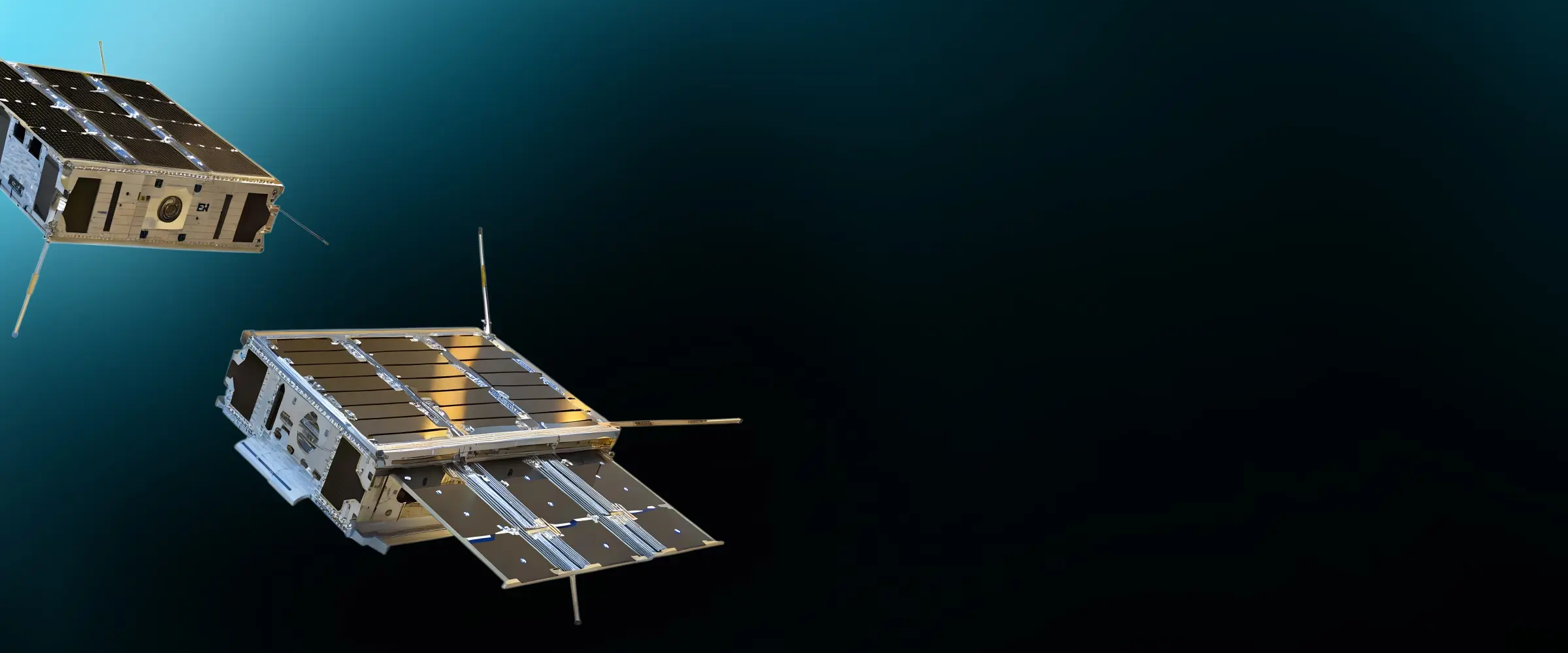
ISPTech’s three in-orbit demonstrations in 2026 will provide the validation needed to convert its multi-million-euro pipeline into signed contracts and expand into defense applications. Success in these demonstrations positions ISPTech towards becoming Europe’s mobility layer for space.
“Over the next ten years, we anticipate an increasing demand for in-space maneuvers that can only be facilitated by chemical propulsion. ISPTech is in a prime position to become the European leader in non-toxic chemical propulsion. Their systems are already way ahead of the competition in terms of performance, stability, and robustness.” - Dr. Maximilian Ochs, Principal at First Momentum
Learn more about ISPTech, and watch the founding story behind HIP11.