Fusion energy has been the technology of the future for seventy years. In the last eighteen months, it started behaving like an industry. Proxima Fusion in Munich closed a €411 million round in July 2026 at a valuation above €2.4 billion, making it Europe's best-funded fusion company. Germany's research ministry funded three national fusion hubs in August 2026. Two hyperscalers have already signed for power that doesn't exist yet: Microsoft with Helion in 2023 for at least 50 MW, and Google with Commonwealth Fusion Systems (CFS) in 2025 for 200 MW.
What they're all buying is baseload: power that runs at full output day and night, in still air and in low-sun months, without a battery behind it. Solar and wind are the cheapest electricity humans have ever produced, and neither delivers firm baseload power on its own. One reason we helped start Telura, a geothermal company pursuing firm, always-on power. Fusion promises the same product from machines that run on hydrogen isotopes drawn out of water, with no long-lived radioactive waste, and it can be built more or less anywhere. It is also extraordinarily power-dense: a fusion plant occupies a fraction of the land a wind or solar farm of the same output needs.
This piece sets out where fusion stands in 2026: what has been demonstrated, what has only been planned, and why we think there is still room for a new company in a field that has already absorbed billions.
Fusion is the process by which two light atomic nuclei combine into a heavier one and release energy. That is the reverse of what happens in today's nuclear power stations. Fission splits heavy atoms such as uranium into lighter fragments. Fusion pushes light nuclei together. The reaction direction gives fusion a different risk profile: no uranium, no chain reaction that can run away, and no spent fuel.
Starting from the lighter elements in the top half of the periodic table, nuclei can be mixed and matched into a large number of possible reactions. This is how elements form in stars, and why you keep hearing that we are all star stuff.
Some of those nuclei are far easier to fuse than others. On Earth, under the temperatures and pressures humans can actually produce, only a few reactions are realistic, which is why the fuel of choice is two hydrogen isotopes: deuterium and tritium.
The attraction is energy density. The new nucleus is slightly lighter than the two originals, and the missing mass leaves as energy via E=mc². Fusion fuel carries something like ten million times more energy per kilogram than coal, oil, or gas, and on the order of a hundred million times more than chemical explosives. Deuterium makes up about 0.0155% of the hydrogen in water. Fusing just that fraction of a single liter releases roughly as much energy as burning 300 liters of gasoline, and about 900 times more than splitting the whole liter by electrolysis and burning all the hydrogen you get out.
The deuterium in one liter of water holds the energy of 300 liters of gasoline.
Getting two positively charged nuclei close enough to fuse means overcoming their mutual repulsion, and the way to do that is heat and pressure. Above roughly 6,000 °C, the gas becomes a plasma. From there, the job is to heat that plasma to well past 100 million °C, hold it, shape it, and keep it off the metal walls long enough for enough reactions to happen to justify the effort. Two established methods do that. Magnetic confinement uses powerful magnets to suspend a continuously burning plasma away from the walls. Inertial confinement crushes a millimeter-sized fuel pellet with lasers so quickly that it fuses before it can fly apart.
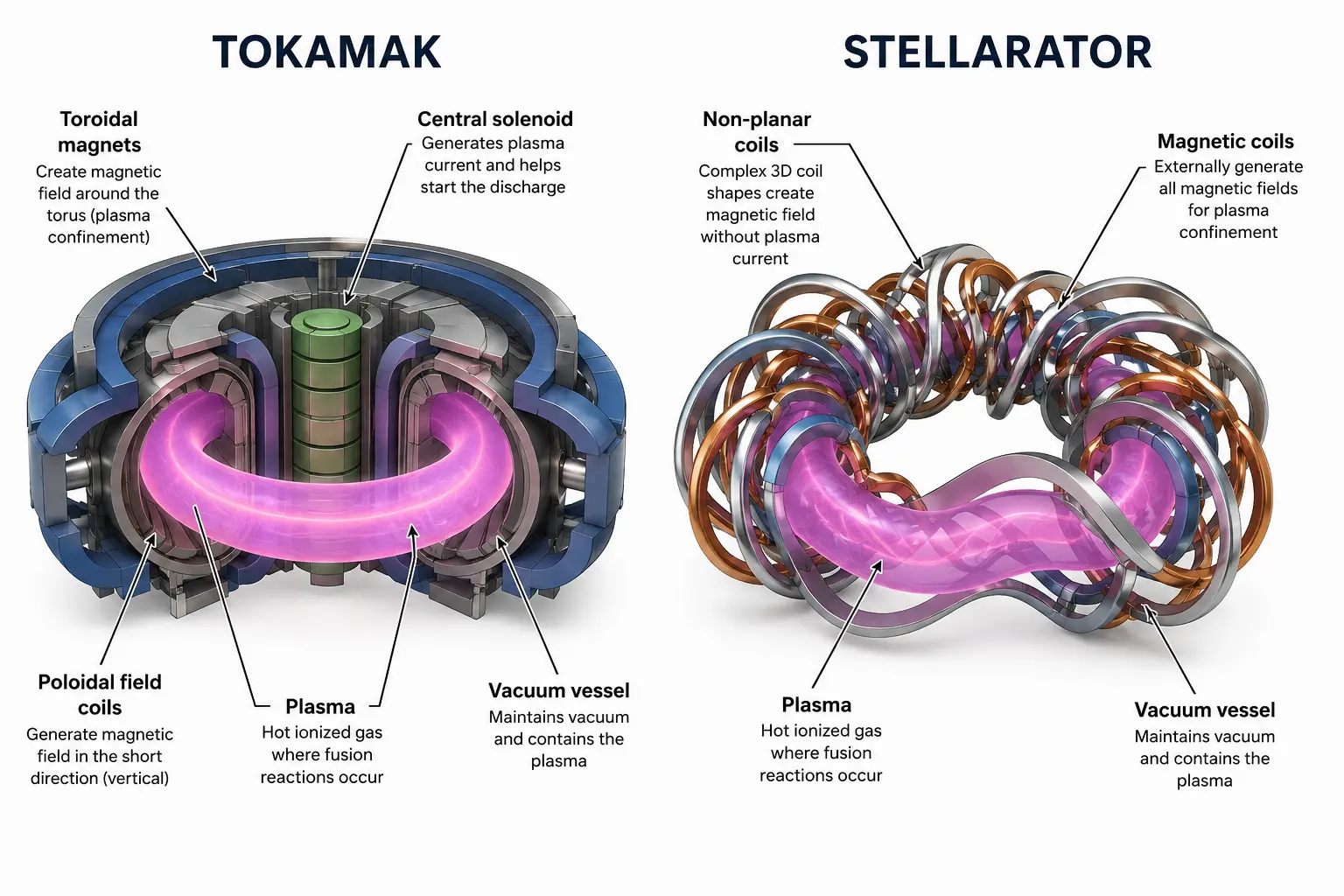
Magnetic confinement then splits again by reactor geometry. A tokamak is a symmetrical ring, shaped like a doughnut, in which part of the confining field comes from an electric current driven through the plasma itself. A stellarator twists that ring into a far more complicated shape so the magnets alone do the whole job, which makes the plasma more stable and the machine much harder to build. Most of the money in fusion today sits behind one of these two designs.
Three parameters decide whether a reactor concept is any good: how much fuel you have, how hot it is, and how long you can hold it there once the external heating stops. Multiply them, and you get the triple product, the figure of merit the field has used to rank machines since the 1950s. Push it high enough, and the plasma reaches ignition, where fusion heating sustains itself. In fire terms, that is the point where you stop throwing in matches.
When fusion happens, the deuterium-tritium reaction produces a helium nucleus and a spare neutron. The neutron carries most of the energy, ignores the magnetic field, flies off in whatever direction it likes, and hits the wall. There, its kinetic energy becomes heat. Run water through the wall, make steam, spin a turbine. The last part of a fusion power plant is a century-old technology.
Fusion produces no CO₂ and no spent fuel. In comparison, fission's spent fuel stays hazardous for tens of thousands of years. That is why the US Environmental Protection Agency requires the Waste Isolation Pilot Plant in New Mexico to remain marked for 10,000 years, with, e.g., concrete thorn fields and pictograms for readers who will share no language with us. Fusion has no spent fuel: its radioactivity sits in structural material activated by neutrons, designed to decay to low-level waste within roughly 100 years. Some fusion steels will still need deep disposal. Even so, a century of managed storage is a different problem from a warning sign built for the next civilization.
It is not renewable, at least not yet. Deuterium is effectively inexhaustible. Tritium is radioactive with a 12-year half-life, which makes it vanishingly rare and extremely expensive. For fusion to sustain itself, the reactor has to breed its own tritium by lining the plasma-facing wall with a lithium "blanket" where escaping neutrons convert lithium into tritium and helium. More on that blanket further down, because it is one of the two or three things standing between the industry and a working plant.
Four forces brought fusion back onto the agenda. Climate targets created demand for firm low-carbon power that solar and wind cannot supply on their own. The underlying technology improved, above all the magnets. Private capital arrived at a scale public programs never had. And the science kept delivering, from ignition in California to record plasmas in Germany. All four still apply. Two of them look materially different in 2026 than they did a few years ago, and those two explain why the field moved from research grants to commercial contracts: the magnets, and the buyer.
Superconducting magnets got much better. ITER, the largest scientific attempt at fusion ever made, uses niobium-tin for its toroidal field magnets. The international project under construction in southern France needed more than 100,000 km of the strand, over 400 tonnes of it. Before ITER, world production capacity for that material ran at about 15 tonnes a year; ITER's procurement drove it to roughly 150 tonnes a year. Then came high-temperature superconductors (HTS), specifically rare-earth barium copper oxide, or REBCO. Stronger fields in smaller, lighter magnets. This single technical input made the current private wave possible: CFS’s whole thesis is a machine with ITER-class fusion power at roughly a tenth the volume. In 2021, they demonstrated a 20-tesla HTS magnet. Tokamak Energy's HTS magnet hit 26.2 tesla at 4 K in 2020 tests at CERN.
The buyer changed. In 2023, the demand-side argument for fusion was decarbonization. In 2026, it is decarbonization plus a hard electricity constraint created by AI infrastructure (we already covered AI as the grid's largest new consumer). Microsoft signed the first fusion power purchase agreement (PPA) with Helion in 2023 for at least 50 MW. In June 2025, Google signed a PPA for 200 MW from CFS's first ARC plant in Chesterfield County, Virginia, half the plant's planned 400 MW output, and took an option on future plants. By mid-2026, the Fusion Industry Association (FIA) counts five companies with a PPA, offtake agreement, or comparable commitment, and six with a siting agreement.
The capital followed. The FIA's 2026 Global Fusion Industry Report puts the industry at $14.24 billion raised since 2021, $4.48 billion of that in the past 12 months, up 69% year on year. 56 companies, up from 23 in 2021, with 28 in the US, and Germany, the UK, and China roughly on par. In July 2026, General Fusion became the first publicly listed fusion company, trading on Nasdaq after a SPAC merger. TAE Technologies has agreed to merge with the Nasdaq-listed Trump Media & Technology Group, with closing expected later in 2026. Fusion is getting a public comparable set, and with it public scrutiny.
Governments moved too. Germany's federal cabinet approved a Fusion Action Plan in autumn 2025, committing more than €2 billion through 2029. In August 2026, the Federal Ministry of Research, Technology and Space funded three national fusion hubs: STRIDE for magnetic confinement, coordinated by IPP with Proxima Fusion and Gauss Fusion, one of our portfolio companies; VEGA for laser fusion at the former Biblis fission site; and a third on fuel cycles and materials. Germany's stated ambition is a first fusion power plant by the mid-2040s.
“We want the world's first fusion power plant to stand in Germany.”
Dorothee Bär, Federal Minister for Research, Technology and Space
Germany is not alone. The UK launched a £1.3 billion Fusion Strategy in early 2026, with UKAEA designing the STEP prototype plant and running LIBRTI, a dedicated breeding-blanket program in the repurposed JET hall. The US DOE published a Fusion Science and Technology Roadmap and funds companies through its Milestone-Based Fusion Development Program, modeled on how NASA seeded private spaceflight. Japan operates JT-60SA, the world's largest tokamak, jointly with Europe. China is building tokamaks faster than anyone, and its BEST device is scheduled to start before 2030.
Money alone will not settle it. Bavaria's offer of up to €400 million for Proxima's Alpha demonstrator shows how conditional these commitments are: it sits under a budget reservation, it only unlocked once Proxima raised matching private capital, and Alpha still needs €1.2 billion from the federal government that has not been committed. The full project costs about €2 billion.
Delivering on that depends on whether European industry can build the components at volume, the same question we raised in what it takes to build Europe's next industrial decades.
This is the most asked question, and the answer needs two numbers. The short version: no machine ever built was designed to reach engineering break-even, so none has. Before commercial prototypes, there was no reason to. Every device to date was built to answer a physics question, and the first machines designed to send more electricity out than they draw in are being designed right now.
Scientific gain, Q_sci, compares the fusion energy produced to the energy delivered into the fuel. On this measure, yes, and repeatedly. The US’ National Ignition Facility (NIF) first crossed Q_sci = 1 in December 2022. As of June 2026, it has achieved ignition eleven times. The record, set in April 2025, is 8.6 MJ of fusion energy from 2.08 MJ delivered to the target, a target gain above 4.
Engineering gain, Q_eng, compares the electricity the plant sends out to the electricity the plant draws in. On this measure, nobody, ever, anywhere. NIF's record shot consumed about 300 MJ from the wall to put 2.08 MJ on target and released 8.6 MJ of fusion energy, roughly 3% of what the facility drew to produce it. NIF was never built to be a power plant; it exists for stockpile stewardship.
Scientific gain: achieved eleven times until now. Engineering gain: never.
The same split applies to magnetic confinement. SPARC, CFS's demonstration tokamak in Devens, Massachusetts, is designed to pass Q_sci = 1, with performance projections around 10. Assembly passed the 75% mark in May 2026 with the second half of the 48-tonne vacuum vessel installed, and the company targets first plasma imminently with net fusion energy in 2027. ARC, the follow-on power plant, is where the plant-scale number appears, and the design figure there is Q_eng of about 3. In the original ARC concept paper, the machine produces 525 MW of fusion power, of which 190 MW reaches the grid, and 64 MW goes back into heating.
Q_eng = 3 is a thin margin by power plant standards. A fission plant spends about 5% of its gross generation on its own pumps, cooling and controls, so it exports roughly twenty units for every one it keeps. A geothermal binary plant, among the more power-hungry designs in operation, can spend 15% or more of its output on pumping alone and still exports around six for every one it uses. A fusion plant designed for Q_eng = 3 recirculates about a quarter of everything it generates. Every good thing anyone says about fusion economics depends on that number climbing across successive generations of machine, which in turn depends on building successive generations of machine.
Nobody in 1955 knew which concept would win. But the physics of what has to be true for fusion to work as a power source was understood then: the fuel, the temperatures, the triple product, the neutron economy, the need to breed tritium.
Since then, progress has been engineering progress, and it has been uneven. Magnetic confinement got the most iterations, so it made the most progress. The tokamak line runs from T-3 in the 1960s through JET, ASDEX Upgrade, and JT-60U; around 60 tokamaks are operating today, all experimental. Plasma turns out to be relatively easy to push, pull, and shape with magnetic fields, which made tokamaks comparatively quick to iterate on. Stellarators solve the stability problem with geometry instead, which made them brutally hard to build until manufacturing methods caught up. Wendelstein 7-X in Greifswald is the payoff: in May 2025 it sustained a high triple product for 43 seconds, matching the best long-pulse results from JET. IPP first called it a record, then corrected itself a month later when the JET team reported unpublished pulses holding comparable values for up to 60 seconds.
The rest of the records sit on different machines. China's EAST has held a plasma for more than 1,000 seconds (nearly 18 minutes), and France's WEST maintained a plasma for 22 minutes. Japan's JT-60U reached ion temperatures around 520 million °C. The highest plasma pressure relative to magnetic pressure, about 35%, belongs to NSTX at Princeton, roughly ten times what W7-X reached. NSTX is a spherical tokamak, and so is ST40, which hit 100 million °C with a plasma major radius of 0.4 meters, compared with JET's 3. No single concept leads on every measure.
Everything else in the parameter space, the field-reversed configurations, plasma guns, mirror machines, aneutronic schemes, got comparatively little fundamental research. Companies exploring those regions today are doing the fundamental research that public institutes were funded to do decades ago for the mainstream concepts, which means starting a rung lower on the ladder. That is the risk profile, and it points in one direction: the concepts with the deepest experimental base are the ones a company can build on without also discovering the physics.
A team working from a well-characterized concept carries engineering risk and manufacturing risk, and both can be put on a schedule. Add physics risk to that, and the schedule stops meaning anything, which is a problem for a company with investors and a burn rate. The reward for solving the engineering is the same either way: whoever industrializes a proven concept sells power plants into a market that has no supplier.
Plenty of serious investors read this the other way and fund unexplored concepts because the risk is priced into a larger payoff, leaving proven concepts to state programs. We think the physics risk is the one venture capital is least equipped to carry.
Read the headlines, and it looks settled: one company has $3 billion and a burning-plasma machine three-quarters built. Look at what has actually been demonstrated, and the picture is more open than that.
No concept has passed engineering feasibility. Scientific feasibility, obeying the laws of physics, is a filter most concepts still have to get through. Engineering feasibility, overcoming the engineering barriers and reaching machine break-even, has been passed by exactly nobody. The FIA's 2026 survey has 28 companies expecting pilot plants operating between 2030 and 2035 and 16 expecting net engineering gain in that window. Every one of those dates is a projection.
Some of the hardest components are the least proven. Tritium breeding blankets are the clearest case. Every deuterium-tritium plant has to breed more tritium than it burns, and no blanket has ever done that in a fusion environment. Six designs are in engineering-scale testing, and the components they depend on, from the lithium-bearing breeder material to the steel that survives the neutron flux to the equipment that pulls the tritium back out, are mostly at TRL 5-6 (working at the right scale but not yet in a working reactor). Modeling says a blanket should breed about 20% more tritium than the plant consumes. In 2025, MIT's PSFC ran the first experiment to actually measure that ratio, and the measurement matched the model. ITER tests its own modules from 2039.
Europe ties its fusion licensing to ITER, which keeps slipping. Before anyone can build a fusion power plant, a regulator has to define how it may be constructed and operated, and no country had fusion-specific rules to begin with. Europe's approach has been to treat fusion under Euratom's fission framework and to use ITER's progress as the basis for relaxing those rules. That ties the licensing timeline of every European fusion company to the schedule of one research machine. ITER's 2016 baseline had first plasma in 2025. The 2024 rebaseline moved the start of research operation to 2034, full plasma current to 2036, and D-T operation to 2039, a four-year slip on that milestone and an extra €5 billion. The abandoned 2025 "first plasma" was, in the Director-General's own words, largely symbolic. The EU's first Fusion Strategy, indicatively due December 2025, is still unpublished as of August 2026, and industry has written open letters asking for it. Germany, the UK and the US are all moving to regulate fusion outside nuclear law.
A fusion company cannot change its mind. Committing to a concept means committing a supply chain, an organization, and a physical machine, and every year of construction freezes the design further behind the state of the art. Every large-hardware program has this property. So a company starting in 2026 encodes a decade of additional results into its baseline, including results from the machines the first wave paid for.
The field's own conventional beliefs are part of the constraint. Linear progress from ITER to DEMO to DEMO 2. A preference for building the most complete and complex machine possible, breeding blankets included, before demonstrating anything commercially. Timelines agreed between political bodies and research consortia rather than derived from engineering.
It is also worth looking at what a demonstrator buys you. CFS's own account of how SPARC research leads to ARC describes SPARC informing how ARC will be operated, not how it will be engineered. UKAEA has made the same point about commercial design: components, materials and manufacturing methods have to satisfy economic criteria from the outset. A demonstrator is a billion dollars and seven to ten years, and the power plant behind it is still designed from first principles.
Nobody knows what a fusion plant costs. A 2026 Nature Energy analysis compiled first-of-a-kind capital cost estimates from experts and the literature and found a range of $1,400 to $43,000 per kilowatt, a 30x spread. The most detailed public costing of a spherical tokamak power plant, the ARIES-ST study, projected 7.86 ct/kWh in 1992 dollars, which inflates to around 15 ct/kWh today.
That number needs a benchmark. Conventional gas and coal generation sits at roughly 5 to 8 ct/kWh, so fusion stops needing a subsidy around 10 ct/kWh. Competing against solar and wind on price is a harder test, closer to 4 to 5 ct/kWh. The leanest credible published projection sits at roughly double the easier target. That gap is what fusion economics is arguing about.
The gap does not close through physics. French fission is the reference case: overnight construction costs for the first plants ran around €6,500 per kW and settled at a stable average of about €1,400 per kW from the 1980s on, a fall of nearly 80% once the design stopped changing.
The ETI Nuclear Cost Drivers study examined 33 completed fission reactor projects across several countries and concluded that the dominant drivers of nuclear cost are not intrinsic to the reactor but sit in design choices and the delivery model. The historical record agrees. The Energy Policy published fission study from above, reviewing construction costs for 349 reactors across seven countries, found that costs escalated severely in the United States while South Korea held them stable. The difference was a standardized design built in a programmatic sequence by a continuous workforce and supply chain.
In the most detailed bottom-up comparison of large reactors against small modular ones, MIT researchers found that modularization by itself does not substantially reduce overnight construction cost. What reduced it, by 30 to 45% in their analysis, was learning-by-doing across sequentially deployed units. Smaller units make serial production possible, and serial production is what produces the learning.
That mechanism is called Wright’s law. In 1936, T.P. Wright observed that labor costs in aircraft production fell 10 to 15% with every doubling of cumulative output, and the relationship has since been confirmed across manufacturing domains from airframes to medical devices. It is the same curve French fission rode down and the same curve the launch industry rode down.
Hardware costs are assumed fall 10-15% with each doubling of production.
Complex, high-stakes hardware has been through this transition before. For four decades after Apollo, rockets were built as national monuments, a handful at a time, and the cost of reaching orbit barely moved. It fell once companies like SpaceX and Rocket Lab started building rockets in factories, at cadence. A 2026 Cambridge study of more than 4,400 launches since 1960 found that every doubling of cumulative payload cut the cost per kilogram by 21%, with the inflection arriving as Falcon 9 entered service. Fusion is roughly where launch was before the cadence began.
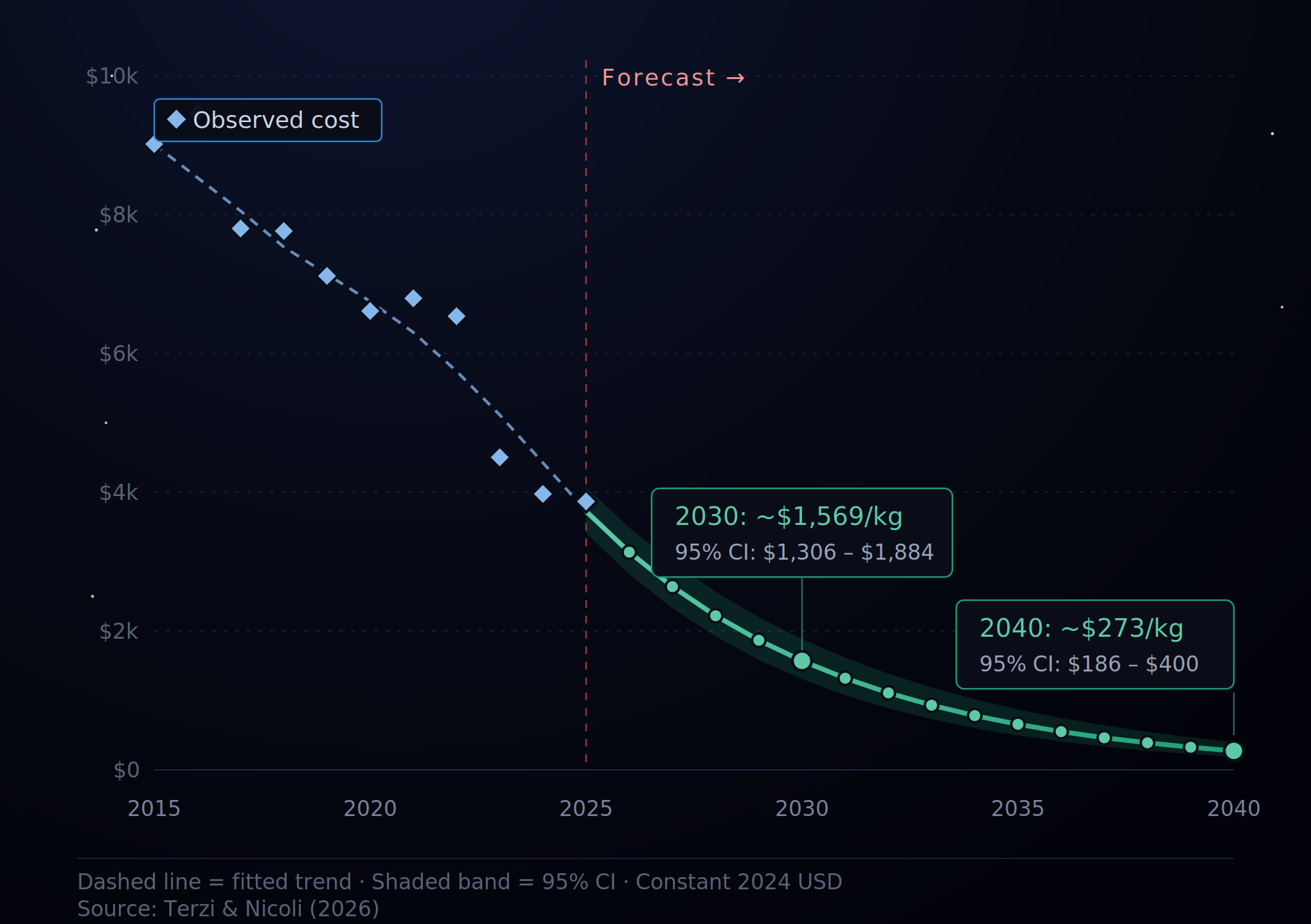
How fast that curve falls is the whole argument, and the literature does not agree. A June 2026 harmonized review of decades of fusion cost studies put the mean levelized cost for mature magnetic confinement at about 11.5 ct/kWh, and got there by implying learning rates above 30%, far steeper than anything Wright measured in aircraft. The review's authors flagged those projections as optimistic compared with similar technologies.
This is also where the strongest criticism of fusion economics lands. The ETH Zurich researchers, who conducted the 2026 Nature Energy analysis mentioned above, argue that fusion cost projections assume experience rates of 8 to 20% when the defensible range is 2 to 8%. They derive those low rates from three specific characteristics of current designs: very large unit size, extraordinary complexity, and a high degree of customization per unit. Their accompanying policy brief tells governments not to treat fusion as a pillar of a clean energy system unless designs with different characteristics emerge.
Unit size, complexity, and customization are design choices, not laws of physics, and the same analysis implies what happens to the curve if all three move. Small modular fission reactors are the live test of that thesis.
So the summary of fusion economics in 2026: the cost of the first plant is unknown within a factor of 30, and rockets, ships, and reactors all got cheap the same way, by being built again, hundreds of times. Which raises the question of who is currently building to reach a hundred.
Fusion's remaining problems are, in large part, manufacturing problems. Three examples from the current supply chain.
Magnet supply is the first. A single CFS model coil uses 270 km of REBCO tape, and SPARC's total procurement across all its magnet systems is approaching 10,000 km. Global fusion-grade capacity runs in the low thousands of kilometers per year, so one machine absorbs several years of world output. Magnets are also the one part of a fusion machine that already has a market. In April 2026, CFS agreed to build magnets for Realta Fusion under a deal the two companies say could reach billions of dollars, a year after licensing its cable technology to Type One Energy. Whoever can make these magnets at volume has paying customers long before the first plant is switched on.
Maintenance is the second. The first wall and blanket degrade under neutron bombardment, so they have to be replaced periodically, and most plant studies assume intervals of a few full-power years. Outage length depends on materials, geometry, and remote-handling strategy, and estimates vary widely. For scale, replacing ITER's 740 blanket shield modules by remote handling is estimated at two years. A plant that spends a large fraction of the year open sells nothing, which is why modular architectures keep appearing in the literature: several smaller units on one site, maintained in rotation so the site keeps delivering. Design for serviceability changes a fusion plant's economics more than most plasma improvements would.
The third is the supply chain's own confidence. FIA's 2026 supply chain report puts fusion companies' combined supplier spend at $538 million in 2025, projected to reach $681 million in 2026. Encouraging, and still small. 69% of suppliers report a lack of long-term visibility into fusion demand, which makes capacity investment hard to justify. The report has called this a chicken-and-egg gridlock for four years running.
Put those building challenges together, and the white spot's shape becomes clear. Almost every serious fusion program is optimized to prove a physics result with one machine. Very few are optimized to produce many machines. Those are different engineering problems with different answers: the first rewards pushing every parameter to the edge of what is achievable, the second rewards standardization, tooling, demountable joints, internal access, a qualified supplier base, and a geometry you can build a production line around.
We think a company can still be built in that second category, and we think the window is open because the first wave has already paid for the expensive part. HTS magnets were validated at a cost of hundreds of millions of dollars. The tokamak is the most thoroughly characterized confinement concept in existence, and the spherical variant now has reached ion temperatures above 100 million °C in a compact high-field machine, a temperature previously reached only in much larger devices with far more heating power. A company starting today can take proven physics as given and spend its engineering budget on manufacturability.
Fusion has had its monuments. What it needs now is a factory.