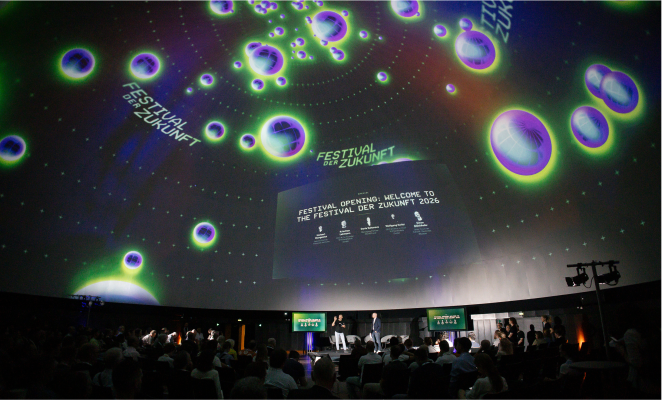
At Festival der Zukunft in Munich, First Momentum's Lena Späth moderated a VC roundtable with four investors who do not usually give the polite answer: Hampus Jakobsson of Pale Blue Dot, Daria Saharova of World Fund, Benedikt von Schoeler of Vsquared Ventures, and Jonas Sommer of DTCF. The premise was familiar. Europe has the science and the industrial base, and has spent ten years saying it is about to turn that into scaled companies.
The question to the room was the obvious one. If the talent and the ideas are here, what is actually still broken? The answers, from four funds backing different sectors at different sizes, pointed at the same thing. Call it a condition gap: the set of things that still need to be true before a European deep tech company can scale at home instead of leaving. Three stood out.
Start with the money, because it is where the mismatch is easiest to see. Deep tech does not move through funding stages the way software does. A company can be technically derisked, the physics works, the first customer pilot lands, and it still will not show the growth metrics a Series B or C investor is trained to look for. What you get instead is a run of extensions and bridges, raised because the standard ladder is missing a rung. That rung has a name: the commercialization gap, the stretch where the technology is proven but the numbers that unlock the next check are not there yet.
"The real need is capital to survive until growth investors are willing to engage."
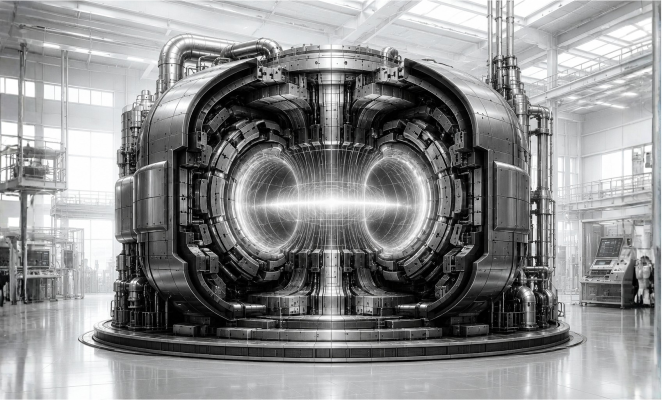
Proxima Fusion shows what it looks like when the gap gets crossed. The Munich fusion company closed a €411 million round in July 2026, three years after its pre-seed, taking total funding past €650 million and its valuation to €2.4 billion. That only works because it could stack the right money in one round: public co-investment (SPRIND, KfW Capital, the EIC Fund), strategic capital (Google, RWE), and returning venture investors, together. Most deep tech companies cannot assemble that combination at the moment they need it.
Our own portfolio has a version of the same story. QuantumDiamonds, a spinout from TU Munich, layered €76 million in EU Chips Act funding under a €15 million equity round to move from seed funding toward a €152 million production facility.
Grants are where it gets complicated, because they cut both ways. China's EV playbook is the encouraging version: seed many companies, let competition pick the winner, end up with a BYD. The European version more often slows a company down. One of our portfolio companies, without access to large grants, outpaced peers who had them, because heavy grant funding tends to come with heavy strings.
"Grants can lock you into three years of milestones, no matter what changes around you."
Fund size is the second ceiling, and this one is structural. The funds in the room ranged from a steady €100 million, kept flat on purpose to stay lean and high-conviction, up to roughly €600 million. Even at the top of that range, US peers running the same strategy can write first checks of €1 million to €35 million and hold reserves to follow on. Most European funds cannot match that.
Capital gets most of the attention. The harder problem, and the one that drew the most frustration on stage, is on the other side of the table. European corporates are not yet the customers deep tech founders need them to be. Innovation managers often sit a step removed from procurement and product, closer to event organizers than buyers. One investor's portfolio company working in genomics closes deals routinely in the US while European corporate buyers are still asking whether the product is vegan.
The counter-model can be seen in a US weather satellite company whose government customers prepaid and helped design the product before it existed. That is procurement working as a forward commitment, not a grant. The European pattern runs the other way, and it shows up most clearly at exit. Rocket Lab's completed acquisition of Munich-based Mynaric in April 2026 is strong European deep tech, sold to an American buyer. Roughly 70 to 80 percent of European deep tech acquisitions land with US buyers, which says as much about missing domestic liquidity as it does about ambition.
Two companies are the model worth copying, and they get there from opposite directions.
"Name the problem you'll pay to solve, and set the deadline. That's it."
The third condition is the softest to measure and, over time, maybe the most important: who decides to found a company, and whether the culture around them treats that as a serious choice. European founders tend to undersell where their US counterparts oversell, though the Americans back it up with faster delivery and faster replies. Deep tech founders are their own case again, the people who spend years inside a problem before they start a company, driven by the problem more than the pitch.
“In much of Europe, ‘entrepreneur’ still reads as salesperson, or worse. Sweden shows how quickly that can change.”
Sweden is the proof that this shifts on a real timeline. Spotify did most of the work, and Swedish founders are now visible in politics and media in a way they simply were not a decade ago. Zalando is the German counterpart that never landed the same way: a genuinely large outcome that never became a cultural reference point. A single Handelsblatt story does not move that. What moves it is mass media reaching the voters, students, and future founders still deciding what a good career looks like.
TUM's CDTM program is the closest thing Germany has to a working model, students who leave with founding a company as a default next step. It deserves to be copied at more universities, and paired with scholarships that reward entrepreneurial ambition alongside grades.
We take the same bet from the investor side. Telura exists because we could not find a geothermal founder to back, so we built the company and assembled the founding team ourselves. Domain conviction, we think, can be built rather than only found.
None of this is news to a founder in Europe. What stood out on stage is that four investors, backing different sectors from different fund sizes, arrived independently at the same diagnosis. Three problems are compounding at once.
The closing line on stage is the one worth keeping: build the best global category leader you can, and sovereignty, decarbonization, and resilience follow from that, not the other way around. At First Momentum, that is the bet we make at pre-seed. Our job between now and a founder's Series A is to close exactly these gaps, with capital structured for deep tech timelines, warm introductions to the corporate and government buyers who can become first customers, and a network of scouts and follow-on investors who do not need the SaaS playbook explained to them.
.webp)