Europe's spinoff ecosystem is producing successful spinouts, but the IP processes and growth capital to scale them are missing. At the Spinoff Summit 2026, we sat down with academia, government, and philanthropy to figure out why and what fixes it.

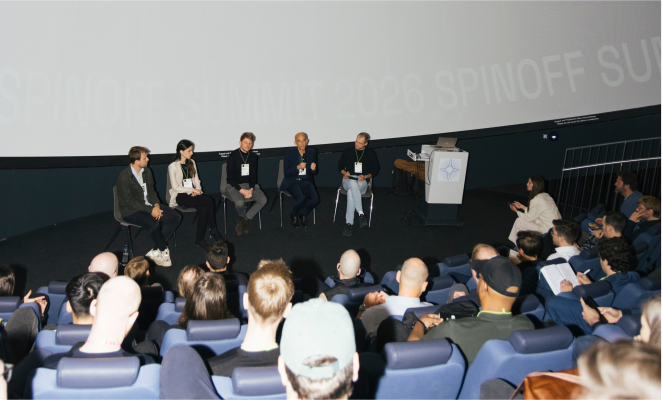
At the Spinoff Summit 2026 in Garching, four people with genuinely different vantage points on the European spinoff ecosystem sat down to talk about it honestly, moderated by Wolfgang Kerler from 1E9.
Ana Benítez-Mateos from TUM brought the academic perspective. Andreas Zaby from SPRIND represented public innovation funding. Max Vellguth from Joachim Herz Stiftung came from the philanthropic side. Our own Sebastian Böhmer joined as founding partner at First Momentum. Here’s what came out of it.
The numbers support cautious optimism. According to data cited during the panel, 76 European spinouts have achieved unicorn status or exceeded $100 million in revenue, with a combined value approaching $400 billion. Over a third of European venture capital now flows into deep tech, roughly double the share from before the pandemic.
That last number matters for a specific reason. The total pool of European venture capital didn't grow dramatically over the last five or six years. Deep tech's share within it did. Founders building in frontier science, advanced materials, quantum, and industrial tech are no longer afterthoughts in the ecosystem.
A decade ago, students saw two paths: stay in academia or join a large company. Entrepreneurship is now a third option.
Ana flagged something that's easy to miss in the headline data: the cultural shift inside universities. A decade ago, students saw two paths: stay in academia or join a large company. Entrepreneurship is now a third option that students take seriously. Munich and ETH Zurich are generating hundreds of funded startups per year. That's the result of real infrastructure being built: venture labs, incubators, networks that simply weren't there before.
First Momentum started on campus at Karlsruhe Institute of Technology. The founding story isn't complicated. We were students who noticed that the infrastructure for turning research into companies was missing, built some of it ourselves, and eventually realized the missing piece was capital that actually understood the work.
Sebastian described the moment the fund idea clicked: a visit to Aalto University in Finland, where a student-run fund was already investing in campus spinouts. Back in Germany, early-stage deep tech founders were pitching to investors whose mental model was e-commerce and B2C software. That mismatch was the gap we built into.
SPRIND fills a different but equally important gap. Germany's Federal Agency for Disruptive Innovation funds high-risk, high-impact projects at the stage where most VCs aren't ready to commit. Namely, after foundational research, but before a company has enough traction to raise a proper private round.
As Andreas explained on the panel, the goal is to bridge that valley by crowding in private capital over time, then stepping back once a team can fund itself. It's a patient model, and it's intentionally designed to make itself unnecessary: if a company no longer needs SPRIND, that's the definition of success.
Together, public funding at that early risk-heavy stage and pre-seed VC like First Momentum cover two adjacent parts of the same problem. The gap that remains is everything after Series A.
The most direct part of the panel was about scaling. Not ideation, not early funding. Scaling.
Europe has strong talent. It has solid early-stage infrastructure. Real research comes out of great institutions. The growth capital needed to take a company from €5 million in revenue to €50 million and beyond is largely absent.
Max co-authored a study with UnternehmerTUM that put a number on this. Germany's venture capital market runs at around €8 billion in 2026, projected to reach €10 billion in 2030. Meeting the capital needs of Series A companies currently in the pipeline through 2030 would require roughly €20 billion per year. That's a €10 billion annual gap, and it compounds. Companies that don't get funded don't exit, and exits are what generate the returns that attract the next wave of institutional capital.
Meeting Series A capital needs through 2030 would take roughly €20 billion a year. Germany's VC market is on track for €10 billion.
The downstream effect is visible today. After Series B, around 70% of capital flowing into European deep tech companies comes from outside Europe. Capital from the US or Asia comes with its own incentives and exit preferences, and they don't always align with the needs of building industrial companies in Europe.
Andreas from SPRIND put it plainly: seven of the ten largest acquirers of European deep tech startups are American corporations. The companies are good enough to buy, but they're not staying European.
The panel covered several levers. None of them is new, which is part of the frustration.
Institutional investors. Most European pension funds run 0% venture capital allocation. In the US, it's a standard part of institutional portfolios. France and the UK have done more to shift this through policy; Germany hasn't caught up. Without institutional money cycling into growth-stage funds, the gap stays open.
IP transfer speed. The average IP negotiation between a spinout founder and their university reportedly runs 18.4 months. That's a year and a half in legal limbo before a founder can raise a proper round. The Dutch IP system came up during the panel as a positive comparison: a simpler process, faster resolution, and a design with the founder's timeline in mind.
The average IP negotiation between a spinout founder and their university runs 18.4 months.
Public procurement. Governments say they support deep tech. Their purchasing behavior tells a different story. Defense is the visible case right now, given current geopolitics, but the same gap exists in healthcare, energy, and education. Startups building for regulated sectors need a first customer. Governments are the obvious candidate. They're mostly absent.
Corporate engagement. Large European corporates are significantly less willing than their American counterparts to buy from or acquire early-stage companies. Sebastian's point was specific: most of the most valuable US companies were founded in the last 30 to 40 years, which makes them faster-moving acquirers of new technology. That's probably the clearest explanation for the exit gap.
Access to research infrastructure. Across First Momentum's portfolio, some companies need access to rocket test stands, particle accelerators, or specialist testing facilities that no early-stage startup can build on its own. Public institutions that open access to these facilities, without prohibitive entry barriers or multi-year queues, directly affect how fast a company can move.
The European deep tech spinoff ecosystem has built genuine substance over the last decade. The Munich and Zurich success stories are the result of years of infrastructure investment, cultural change, and patient capital. Hamburg only got its stakeholders aligned in late 2024. Even large, well-resourced cities can take a long time to get this right.
Germany is losing an estimated 10,000 industrial jobs per month. The companies that could replace that output are being built right now, often on university campuses. Getting them to scale requires closing the growth capital gap, fixing the IP transfer process, and persuading institutional investors and governments to act accordingly.
That's why we co-host the European Spinoff Summit each year. By bringing investors, spinoff founders, academia, and public institutions into one room, we align the incentives, capital, and expertise required to scale Europe's next generation of deep-tech champions.
First Momentum also tracks the benchmarks every year in the Deep Tech Napkin. The direction is right. The question is speed.
Sebastian Böhmer joined the Ecosystem Panel at the Spinoff Summit 2026 in Garching. First Momentum is a pre-seed deep tech fund and co-host of the European Spinoff Summit.