Trapped ions are one of the most mature quantum computing platforms. They deliver the highest gate fidelities and the longest coherence times of any qubit type, with full all-to-all connectivity. Each ion is perfectly identical and ion qubits do not suffer from manufacturing imperfections. On paper, they're the best quantum bits available.
But they face a fundamental scaling problem.
Traditional Paul traps, the architecture used by Quantinuum and IonQ, confine ions using radio-frequency (RF) electric fields. This creates a 1D chain of ions. Beyond roughly 50 individually addressable qubits, the chain hits hard physical limits: the ions start interfering with each other and gate fidelities degrade. In addition, connecting different qubits to each other becomes impractical. In order to move ions from left to right, they need to jump or shuttle over other ions. This slows down the entire operation.
The workaround is connecting many short 1D segments into a quasi-2D grid using junctions. Quantinuum's H2 processor takes this approach. It works, but qubit density stays limited because ions can only move one at a time, queued along fixed grid-junction lines. With a few dozen qubits, the shuttling overhead is manageable. With thousands, it becomes the bottleneck.
The result: trapped ions have proven they can run the most precise quantum operations of any platform, but can't yet run enough of them to be industrially useful. No hardware platform has demonstrated a clear path to the thousands of qubits needed for fault-tolerant computing yet.
ZuriQ's Penning micro-trap array takes a fundamentally different approach. Instead of RF fields, it uses static electric fields combined with a static magnetic field. This combination traps ions in two dimensions directly, with no junctions needed.
Prof. Jonathan Home of ETH Zürich explains the core advantage:
"What makes this approach powerful is geometry. Hold ions in a line and the count grows one at a time. Hold them in two dimensions, and it grows with the area of the chip, on a standard chip, that is the difference between tens of ions and many thousands."
The practical consequences are significant:
A critical advantage: Penning traps maintain full compatibility with the control techniques developed over decades by the trapped-ion community. ZuriQ doesn't need to reinvent laser control, readout, or error correction. It uses the same proven toolset on a better-scaling architecture.
The static fields also simplify chip fabrication. RF electrodes generate heat and add design constraints. Without them, ZuriQ's trap chips can be manufactured using standard CMOS processes, which is the basis for their design partnership with Infineon Technologies.
ZuriQ spun out of ETH Zurich in April 2024, built on research from Prof. Jonathan Home's trapped-ion physics group, the most advanced Penning trap lab in the world.
Dr. Pavel Hrmo (CEO) brings 10 years of direct experience in Penning trap physics. He completed his PhD at Imperial College London and did postdoctoral work at the University of Innsbruck in Rainer Blatt's group, one of the top quantum research groups globally. He then spent 3 years leading the Penning trap research at ETH Zurich. He combines deep physics knowledge with a clear ability to communicate the vision and execute on company-building milestones.
Dr. Tobias Saegesser (CTO) studied engineering at ETH and built ZuriQ's experimental lab from scratch. He co-authored ZuriQ's foundational 2024 Nature paper and led the team's 2026 Science Advances study on 3D ion positioning.
Dr. Shreyans Jain (CSO) started the project as an intern, then continued through his Master's and PhD. He did all the theoretical calculations and simulations that underpin ZuriQ's architecture.
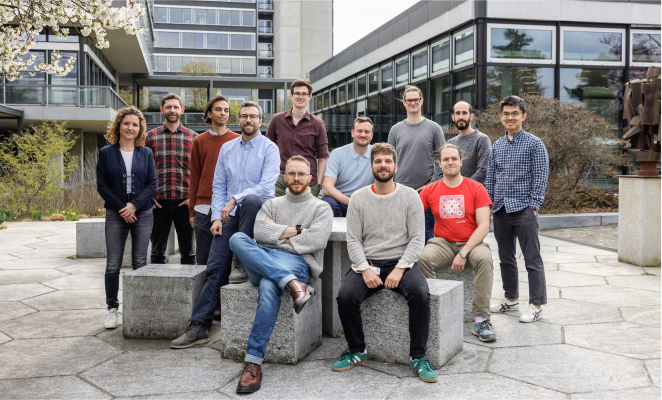
The 3 co-founders have worked together for years and published the foundational results together. Prof. Home advises the company.
The team has grown to 10+ full-time employees, all in technical roles. By July 2026, headcount reached 18, with new hires from IonQ, Xanadu, and Hamamatsu. Plus, they were selected for the QAI Ventures Accelerator and maintain a corporate partnership with the ETH Quantum Center.
Quantum computing is projected to create up to $2 trillion in value by 2035, with the largest impact in chemicals, life sciences, finance, and mobility (McKinsey). In 2025, McKinsey reported for the first time a shift "from development to deployment," marking a transition from research curiosity to commercial urgency.
VC investment reflects this. Quantum companies raised a record $3.9B in 2025, roughly double 2024's total. Public investment is projected at $40-50B over the coming decade. Valuations confirm how seriously the market takes trapped-ion IP. IonQ acquired Oxford Ionics for $1B in stock in 2025.
The hardware race is still open. No single architecture has won. Superconducting qubits (Google, IBM), photonic approaches (PsiQuantum, Xanadu), neutral atoms (Pasqal, QuEra), and trapped ions (Quantinuum, IonQ) are all competing. Different architectures might even serve different applications.
Christophe Jurczak, founding partner at Quantonation and lead investor in ZuriQ's seed round, echoes this read of the market:
"A common misconception is that the quantum race is already decided, but that is far from reality. ZuriQ is demonstrating that there remain significant and transformational physics breakthroughs still to be made in quantum architectures."
ZuriQ has moved from lab research to hardware milestones faster than peers with significantly more capital.
In 2024, the team published in Nature the first experimental demonstration of 2D ion movement in a Penning micro-trap. In early 2025, ZuriQ raised a $4.2M pre-seed round to build on those results. They've successfully trapped 4 ions in a 2D array and moved them in 3D, then built a working demonstrator: a 3x3 array of nine individually controlled ions, the largest two-dimensional ion array demonstrated to date, developed in 18 months and fabricated on Infineon's line.
They've also demonstrated the first-ever 2-qubit gates in a Penning trap, a result no other group in the world has achieved. ZuriQ is now building a 40-ion chip, the next step toward thousands of qubits.
In May 2025, ZuriQ signed a design partnership with Infineon Technologies for next-generation trap chip fabrication. This gives them access to industrial-grade manufacturing capabilities without building their own fab.
ZuriQ sits at the center of First Momentum's thesis: fundamental science transitioning into engineering execution. The company is doing exactly what we look for, taking a deep technical advantage developed over a decade of research and turning it into a product on an aggressive timeline.
The Penning trap architecture has a clear technical case for scaling trapped ions beyond what Paul traps can achieve. This matters for competitive defensibility. If Penning traps prove to be the winning approach, incumbents can't easily switch. The architecture is fundamentally different, requiring different chip designs and entirely different physics.
ZuriQ is the most advanced Penning trap company in the world. No other team has demonstrated 2-qubit gates in a Penning trap. No other team has published comparable results. This creates a first-mover advantage that's hard to catch up to.
Dr. Pavel Hrmo, ZuriQ's co-founder and CEO, frames the strategic bet the same way:
"We spent longer in the lab, and that time allowed us to identify an alternative route that is inherently easier to scale. Our architecture is two-dimensional from the ground up, so the number of qubits we can place on a chip will grow far more readily than in systems built on a legacy blueprint."
Dr. Maximilian Ochs, deal lead at First Momentum, puts it directly: "ZuriQ combines the strongest fundamental physics with engineering speed. The Penning trap architecture solves the scaling bottleneck that has held back ion traps for a decade, and the team has proven they can translate lab results into hardware milestones faster than competitors with 10x the funding."