Privately funded fusion companies have raised $14.24 billion since 2021 and have not yet sent a net watt to the grid. In September, we wrote about why fusion is not built like cars: every fusion machine since the 1950s was built to answer a physics question, but the part nobody has built is the factory.
Electricity demand is rising fast, driven by electrification, data centers, and AI, and we have written before about the grid's largest new consumer. Meeting that demand takes clean power that runs day and night, in still air and in low-sun months. Our portfolio already covers two other ways to get there: Telura is making geothermal power work in places without volcanic geology, and Turn2X turns renewable electricity into pipeline-ready gas that can be stored and burned when the sun is down. Fusion is one of the few sources that can deliver baseload energy at scale, and in Europe it would be generated here instead of imported.
Fusion fuel carries about ten million times more energy per kilogram than coal, oil, or gas, and the deuterium in a single liter of water holds about as much energy as 300 liters of gasoline. A fusion plant also occupies a fraction of the land a wind or solar farm of the same output needs. For an investor in energy, that combination of density and firmness is the reason to keep looking even when the sector has a seventy-year record of missed dates.
So we kept looking. We have met many fusion companies over the past years, across confinement concepts and geographies, and the question we kept testing was not which plasma result was best. It was where the cost comes down. Energy technologies become part of everyday life when the cost curve bends, and in hardware the curve bends through repetition.
Energy technologies become part of everyday life when the cost curve bends, and in hardware the curve bends through repetition.
That filter kept returning the same answer. Almost every serious fusion program is optimized to reach a result on a single machine, and very few are optimized to produce many machines. Those are different engineering problems: the first rewards pushing every parameter to the edge of what is achievable, the second rewards standardization, tooling, demountable joints, internal access, and a geometry you can build a production line around. We could not find a European company built for the second problem. In the end, we started one.
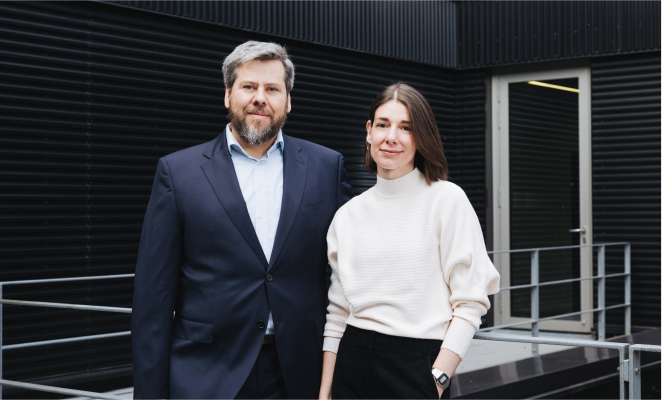
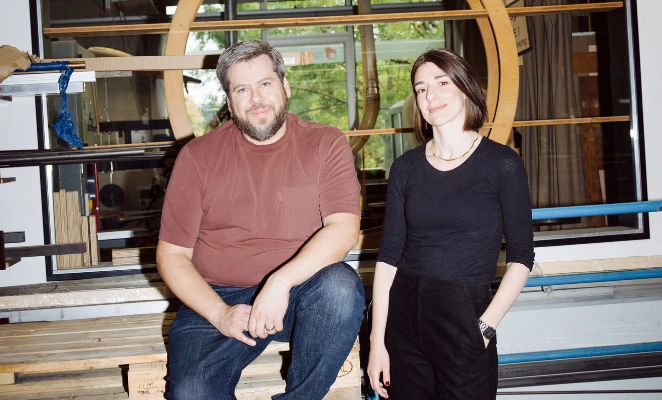
Ana, Co-founder and CEO of Starforge, holds a dual PhD in plasma physics and nuclear fusion engineering. She has worked at the Max Planck Institute for Plasma Physics and the MIT Plasma Science and Fusion Center, on multiple world-class research and demonstration tokamaks, and was an early employee at Commonwealth Fusion Systems, the largest private fusion company globally. Before founding Starforge, she was Head of Research and Investor at First Momentum, where we worked on this question together for a long time and in a lot of detail.
What hooked the team was her answer. She saw making fusion work as a matter of time and wanted to industrialize it, with design choices to match: a compact spherical tokamak, a reactor you can open and service, and standardized units built in series.
Jonathan, Co-founder and COO, has spent his career bringing hardware from the lab to the factory floor. After nine years working on new manufacturing technologies at GE Global Research, he moved to GE Aviation Germany, where he helped ramp up a new turbine blade casting plant. At Lilium, he set up multiple manufacturing engineering teams and later headed the function as the company moved into production. At VoltStorage, he built and led the manufacturing team that enabled the company to deliver its first industrial-scale iron-salt battery demonstrator. He is a named inventor on nine patents.
We introduced them through Istvan Keszte, one of our venture scouts. Starforge is our second incubation after Telura, where we put a founding team together the same way. A few months later, they raised an oversubscribed €6.6m pre-seed round.
We haven’t seen this combination before in fusion: deep reactor physics on one side, and manufacturing experience bringing complex hardware to life on the other.
Starforge's thesis is that fusion reactors get cheaper the way other complex hardware did, by building the same machine many times. So far, the evidence for that comes from outside fusion (no fusion reactor has been built in series yet).
In 1936, T.P. Wright observed that labor costs in aircraft production fell 10 to 15% with every doubling of cumulative output, and the relationship has since held across manufacturing domains from airframes to medical devices. French fission is the reference case in power: overnight construction costs for the first plants ran at around €6,500 per kW and settled at about €1,400 per kW from the 1980s on, a fall of nearly 80% once the design stopped changing.
The mechanism is specific, and that specificity matters. The Energy Technologies Institute's Nuclear Cost Drivers study examined 33 completed fission reactor projects and concluded that the dominant drivers of nuclear cost are not intrinsic to the reactor but lie in design choices and the delivery model. In the most detailed bottom-up comparison of large reactors against small modular ones, MIT researchers found that modularization by itself does not substantially reduce overnight construction cost. What reduced it, by 30 to 45%, was learning-by-doing across sequentially deployed units. Building smaller is what makes serial production possible, and serial production is what produces the learning.
Building reactors in sequence, rather than one at a time, cuts capital costs by 30 to 45%.
The strongest criticism of fusion economics goes in the same direction. ETH Zurich researchers argue in Nature Energy that fusion cost projections assume experience rates of 8 to 20% when the defensible range is 2 to 8%, and they derive those low rates from three characteristics of current designs: very large unit size, extraordinary complexity, and a high degree of customization per unit. Their policy brief tells governments not to treat fusion as a pillar of a clean energy system unless designs with different characteristics emerge.
When incubating Starforge, we read that as a design brief rather than a verdict. Unit size, complexity, and customization are choices. Starforge's conservative model assumes each doubling of production cuts cost by 15%, and applies that learning specifically to the factory-produced reactor core rather than to the whole plant, where the empirical basis is weakest. Out of that comes electricity at around 5 ct/kWh once reactors are produced and deployed at fleet scale. Conventional gas and coal generation runs at 5 to 8 ct/kWh, so that number needs no subsidy to compete.
The space launch industry is the closest recent example. For four decades after Apollo, rockets were built as national monuments, a handful at a time, and the cost of reaching orbit barely moved. It fell once companies started building rockets in factories, at cadence: SpaceX flew Falcon 9 165 times in 2025, and Rocket Lab builds Electron and its engines in dedicated high-rate production facilities. The sequence there was repeatability first and manufacturability second: make the same thing the same way, then make it faster and cheaper. Starforge designs every component for repeated factory production, and builds the reactor around those components.
A fusion reactor is a machine in which magnets, heating, vacuum, and cooling systems work together. Fusion happens only under the conditions this machine creates: a plasma many times hotter than the core of the Sun, held in place by magnetic fields. Machines like this can be built on production lines, in the way the world already builds aircraft engines and wind turbines. Geometry decides which machines can take that route, because a machine goes on a line only if it is small enough to leave the building.
Starforge chose the spherical tokamak, a compact design with high fusion power density that still works economically at a smaller size. The plasma is the hot, charged gas where fusion actually happens. Everything else in the machine is there to hold it in place and carry its heat away. The compactness is measurable in how much of a machine's volume is doing the energy-producing work: in a stellarator and a conventional large tokamak, only a few percent of the machine's volume is fusion plasma. In a compact tokamak, that is close to 50%, but in a spherical tokamak (Starforge's design platform), it's well above 50%. Everything outside that fraction is steel, magnets, cryogenics, and structure that has to be manufactured, transported, and eventually maintained.
In conventional large tokamaks and stellarators, only a few percent of the reactor volume is the heat-producing plasma. In Starforge’s design, it’s well above 50%.
At 200 to 300 MWe, each reactor falls within the International Atomic Energy Agency's definition of a small modular reactor. That is also the scale at which factory production, volume procurement, and serial construction become accessible at all. Compact does not mean underpowered: the spherical shape confines plasma more efficiently at a given magnetic field, which is what lets a smaller machine reach power-plant conditions. The spherical variant has reached ion temperatures above 100 million °C in a compact high-field machine, a temperature previously reached only in much larger devices with far more heating power.
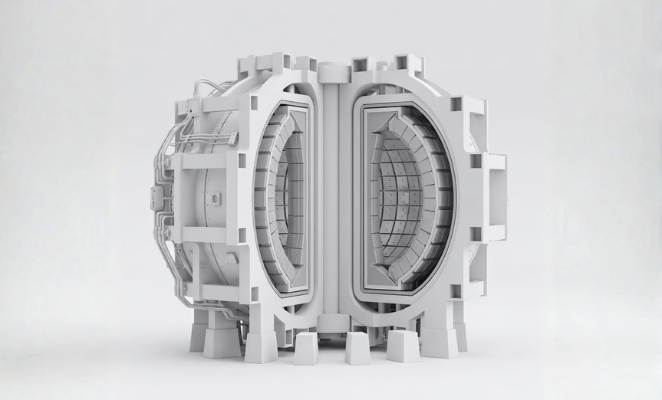
Every deuterium-tritium reactor produces high-energy neutrons that embed themselves in the surrounding steel, which makes the material brittle over years of operation. A reactor running at full power therefore has a useful structural life on the order of a decade before its core components have to be replaced. If the machine is not designed for maintenance, component life becomes plant life, and the capital cannot be amortized over the 30- to 40-year horizon that makes baseload generation work.
Starforge's first reactor, Unit One, will be built around remountable high-temperature superconducting magnets and modular reactor systems, which let components be serviced and replaced in the field without rebuilding the machine, across a reactor lifetime of more than 40 years. This reduces downtime and maintenance costs, which makes serviceability one of the key levers for affordable fusion. In a plant with several units, the arithmetic goes further: reactors are serviced in sequence while the rest keep generating, which lifts plant uptime well above what a single-unit nuclear plant achieves.
None of these principles is new. Conventional power plants have operated for decades through scheduled component replacement, and multi-unit facilities have long used sequential maintenance to keep generating capacity online. The challenge for fusion is to design a machine that allows these established principles to work.
Serviceability is the second half of Starforge's business model. Every reactor it sells comes with decades of planned maintenance, replacement modules, and upgrades, so each unit in the field remains a customer long after delivery.
Replacing life-limited components instead of the machine turns a ten-year device into a forty-year plant.
In fusion, the reactor is the only part of a power plant yet to become an industrial product. Fission solved that structurally decades ago: reactor vendors such as Westinghouse, Framatome and Rolls-Royce supply the reactor, while other specialists supply turbines, grid connections and project finance. Starforge will build the reactor and slot it into the procurement processes utilities and governments already use, leaving power plant development and electricity sales to its customers.
That also widens who can buy. Customers can add capacity unit by unit, which opens fusion to buyers beyond national grids, including data centers, district and industrial heating, and remote research and defense sites. It is the same argument we made about Europe's next industrial decades: the continent competes where it can build components at volume, not where it can commission one landmark project.
Fission has had reactor vendors for decades. Fusion has none.
Germany is one of Europe's most committed countries to fusion, with more than €2 billion pledged through 2029, three national research hubs funded in August 2026, and a goal of building the first fusion power plant by the mid-2040s. Starforge is targeting first commercial operations in the mid-2030s. Its first reactor can serve as its prototype, first-of-a-kind unit, and first commercial product.
Starforge is the company we could not find. The company designs fusion reactors as standardized products that will be built on production lines and sold to the utilities, governments, and private asset owners who build nuclear power plants today.
With Starforge, First Momentum now backs both leading magnetic confinement designs. Gauss Fusion is building a stellarator and is part of Germany's STRIDE hub; Starforge is building a spherical tokamak.
Fusion's first wave paid for the expensive part. High-temperature superconducting magnets were validated at a cost of hundreds of millions of dollars, the tokamak is the most thoroughly characterized confinement concept in existence, and a supply chain has started to form. A company starting in 2026 can take proven physics as given and spend its engineering budget on manufacturability. What remains is execution. That is a risk you can put on a schedule, and it is the kind of risk we argued venture capital is better equipped to carry than physics risk.
We co-led the pre-seed round with AENU, and Auxxo, Kvanted, Silicon Roundabout Ventures, UnternehmerTUM Funding for Innovators, and Arcas joined. The €6.6m goes into growing the team over the next 24 months, de-risking and advancing the key reactor technology, completing the conceptual design of Unit One, and getting initial commitments from reactor customers across Europe.
"Every great energy technology became part of everyday life once we learned to build it over and over again, and fusion will be no different. Starforge wants to make fusion boring."
Dr. Ana Koller, CEO and Co-founder, Starforge
We think that is the right ambition, and it is also a manufacturing statement. The first reactor is already a product, and every one after it is cheaper. That is how fusion stops being thirty years away.
This is our why. Starforge's plan covers the how, which fits in one line:
fusion, built simply to power the planet.